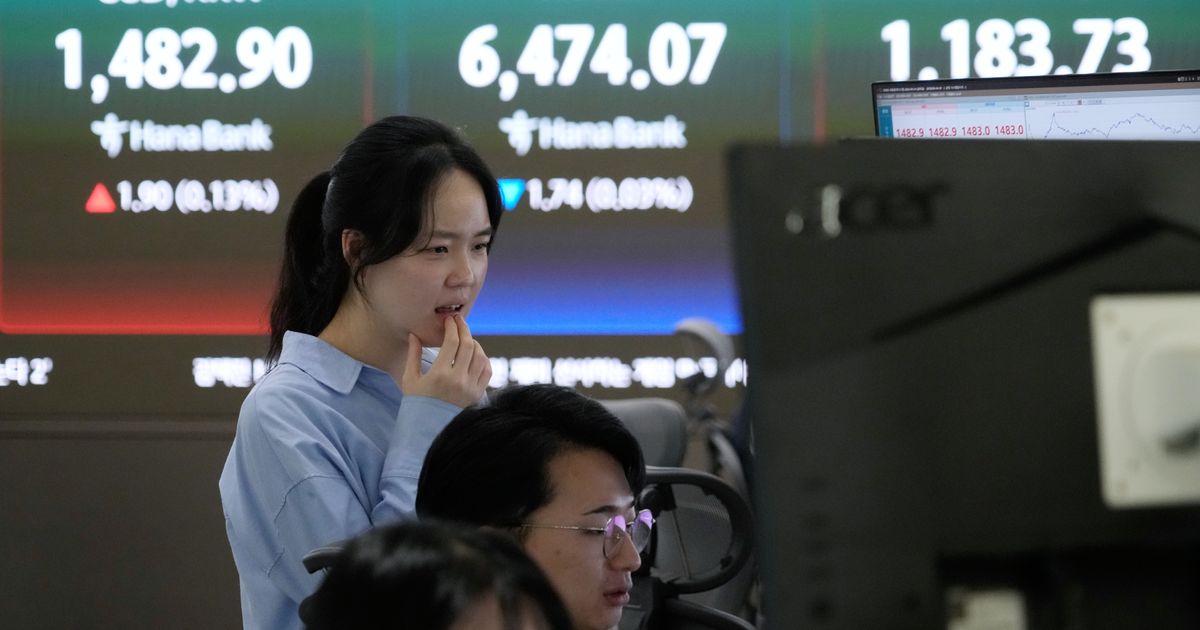
Brent crude rose 3.1% Thursday to $105.07 for June delivery and was still up to $99.37 early Friday as stalled U.S.-Iran peace talks kept the Strait of Hormuz disrupted. Asian equities were mixed, with Japan's Nikkei up 1% to 59,716.18 and Taiwan's Taiex surging 3.2%, while U.S. futures wavered after Wall Street pulled back from record highs. The S&P 500 fell 0.4% to 7,108.40, the Dow lost 0.4% to 49,310.32, and the Nasdaq dropped 0.9% to 24,438.50.
The market is pricing this as a contained geopolitical shock, but the more important second-order effect is duration risk: if the Strait of Hormuz remains impaired for even a few more weeks, the inflation impulse will migrate from headline energy into freight, chemicals, airlines, and time-spread hedging demand. That matters because the initial equity reaction is still being led by cyclical growth/tech rather than defensives, which suggests positioning is not yet fully aligned with a higher-for-longer input-cost regime.
TSMC’s strength is more than a Taiwan-specific headline move; it signals that investors are willing to pay up for supply-chain winners with pricing power and critical-node exposure while de-risking the broader hardware complex. The offset is that a sustained oil shock can eventually pressure global consumer electronics demand and cloud capex sentiment, but that typically lags by 1-2 quarters. Near term, semis with dominant foundry leverage can keep outperforming even if the broader market softens.
TSLA is the most fragile equity expression of this tape. The issue is not the reported quarterly numbers but the market’s read-through on capital intensity: when rates, energy, and geopolitical uncertainty rise together, investors usually punish “growth-with-heavy-future-spend” stories first. WBD is a cleaner short than the headline suggests because merger overhang plus higher fuel/transport costs weaken ad-budget visibility and leave limited fundamental upside until deal mechanics clear.
The contrarian risk is that consensus may be overestimating how quickly the energy shock translates into broad earnings damage. If diplomacy reopens shipping lanes, oil can mean-revert fast and the current macro scare unwinds just as systematically as it built. That argues for keeping trades tactical, with options preferred over outright equity shorts where the catalyst window is asymmetric but not guaranteed.
AI-powered research, real-time alerts, and portfolio analytics for institutional investors.
Request TrialOverall Sentiment
mildly negative
Sentiment Score
-0.15
Ticker Sentiment
