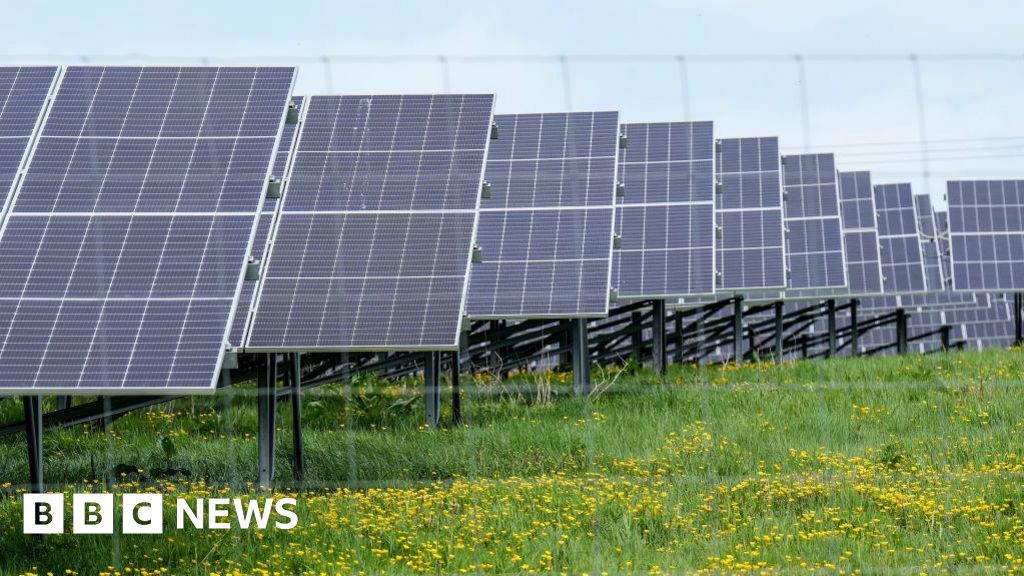
The UK awarded contracts to a record renewables package, securing 4.9 GW of solar across 157 projects (fixed at £65/MWh in 2024 prices for 20 years) and about 1.3 GW of onshore wind at £72/MWh, alongside a small number of tidal awards. The auction advances the government's 2030 clean-power ambitions (targeting 45–47 GW of solar, potentially 54–57 GW with rooftop), provides long-term price certainty tied to inflation for developers, and includes a £1bnLocal Power Plan fund for community energy — though analysts warn of grid and delivery challenges and some local and political opposition.
Market structure: Winners are UK transmission owners (National Grid NG.L), contracted solar developers and renewables yieldcos (TRIG.L, GCOW.L) and battery/storage project developers as 4.9GW of solar at a fixed £65/MWh is added now; losers are merchant gas generators (pressure on spark spreads) and smaller uncontracted developers facing lower clearing prices. The auction shifts pricing power toward large developers with grid access and balance-sheet strength; government targets (45–47GW by 2030 vs ~21–24GW today) imply ~20–30GW of incremental builds, driving multi-year demand for grid upgrades and storage.
Risk assessment: Tail risks include large-scale grid curtailment or connection delays (months–years) that strand assets, adverse policy reversals or retroactive subsidy changes (political tail), and winter gas-price spikes that temporarily revalue gas plants. Immediate risks (days–weeks) are local planning backlash and financing squeezes; short-to-medium (3–18 months) are availability of grid connections and capex inflation; long-term (2–5 years) hinge on storage rollout and actual FID rates. Hidden dependency: delivered generation value depends more on solved local network constraints than auction price alone.
Trade implications: Favor exposure to regulated grid operators (establish 1–3% core long in NG.L over 12–36 months) and defensive, contracted yieldcos (build 3–5% longs in TRIG.L/GCOW.L) to capture stable cashflows and dividends; trim or hedge UK gas-exposed generation (e.g., reduce/short DRX.L 1–2%) as summer solar cannibalizes spark spreads. Use 9–18 month call spreads on SSE.L to lever policy continuity and offshore/onsite synergies; overweight battery/storage suppliers only after clear 12–18 month evidence of sustained storage procurement and revenue stacking.
Contrarian angles: Consensus understates grid-connection risk and local opposition; the £65/MWh clearing price compresses developer margins and could force consolidation—watch small-cap developers for distress. Reaction may be underdone in network-capex beneficiaries and overdone for merchant generators; historical parallels (Spain’s tariff retrofits) warn to demand explicit connection/completion triggers before committing equity. Key unintended consequence: rapid build without commensurate storage/network upgrades could increase curtailment and lower realized capacity factors by 10–30% in summer months.
AI-powered research, real-time alerts, and portfolio analytics for institutional investors.
Request DemoOverall Sentiment
moderately positive
Sentiment Score
0.35
