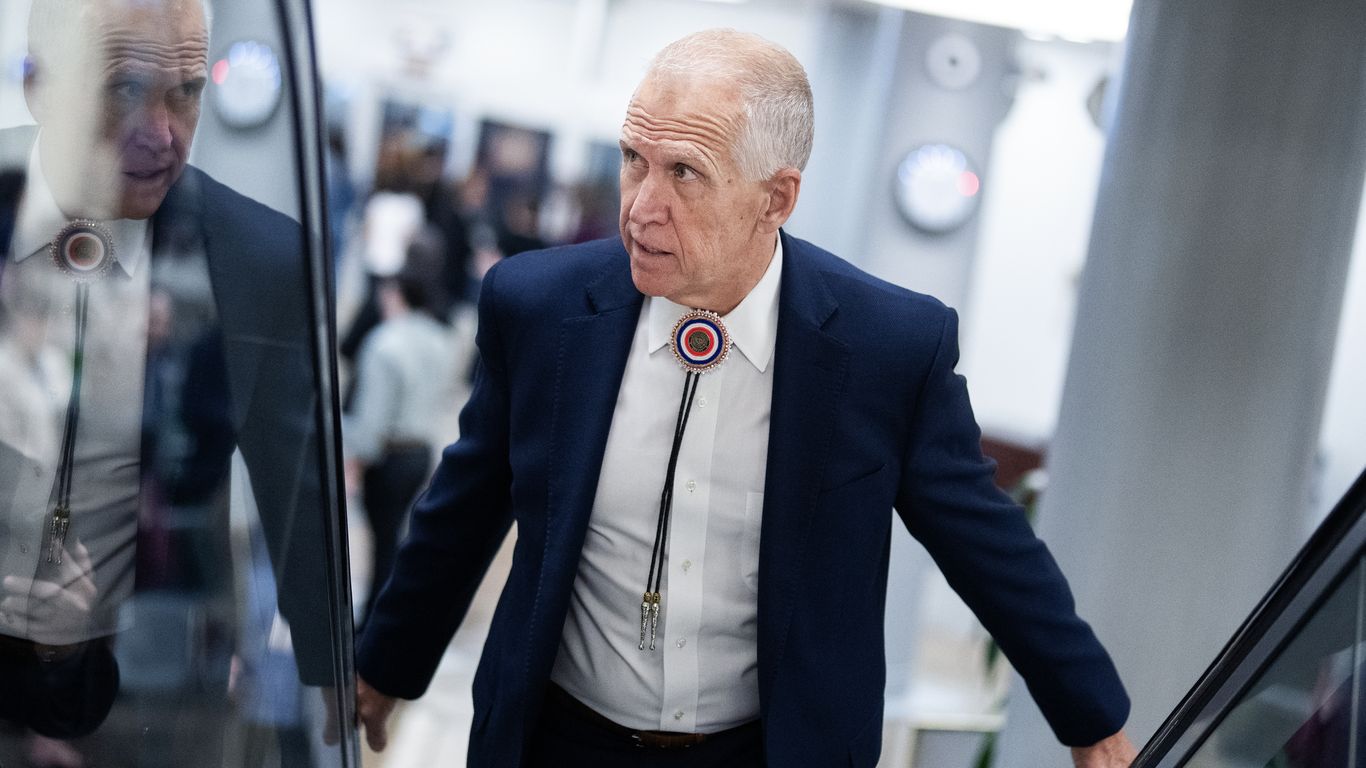
Sen. Thom Tillis said he will not support the budget reconciliation bill if the Senate votes this week, putting the GOP's $72 billion package at risk. His objections center on timing and any funding tied to President Trump's ballroom, while several Republican senators also object to the $1 billion Secret Service component. The dispute could complicate passage in the Senate and create added political pressure on vulnerable Republicans ahead of upcoming primaries.
The immediate market issue is not the bill’s policy content but sequencing risk: a floor delay or visible intra-party revolt increases the odds of a stop-start process that keeps Treasury issuance assumptions, agency funding expectations, and defense/contractor budget visibility in limbo for another 1-3 weeks. That kind of uncertainty usually matters less for index-level equity direction than for rate vol, short-dated credit, and any sector trading on federal spending cadence, because managers will de-risk into headlines until procedural clarity emerges.
Second-order, the ballroom dispute is a useful proxy for GOP cohesion rather than a standalone fiscal issue. If leadership cannot corral votes on a politically symbolic line item, it raises the probability that more material reconciliation offsets get watered down in committee or floor amendments, which would be mildly bearish for deficit-sensitive rates positioning and modestly supportive for duration if the market starts pricing a higher chance of a smaller fiscal impulse. The more important signal is that senators facing primaries are optimizing for local campaign time, not legislative discipline, which tends to elongate the path to enactment even if final passage still happens.
The contrarian angle is that this may be a headline-driven delay, not a substantive defeat. Because the main reservation appears procedural and reputational, a last-minute rewrite or side letter could unlock support quickly; that argues against chasing a large macro short in risk assets. The cleaner expression is in dispersion: sectors and names with the most direct federal spending sensitivity should underperform on every delay, while broad market beta may fade the issue once the vote schedule is reset.
AI-powered research, real-time alerts, and portfolio analytics for institutional investors.
Request DemoOverall Sentiment
mildly negative
Sentiment Score
-0.15
