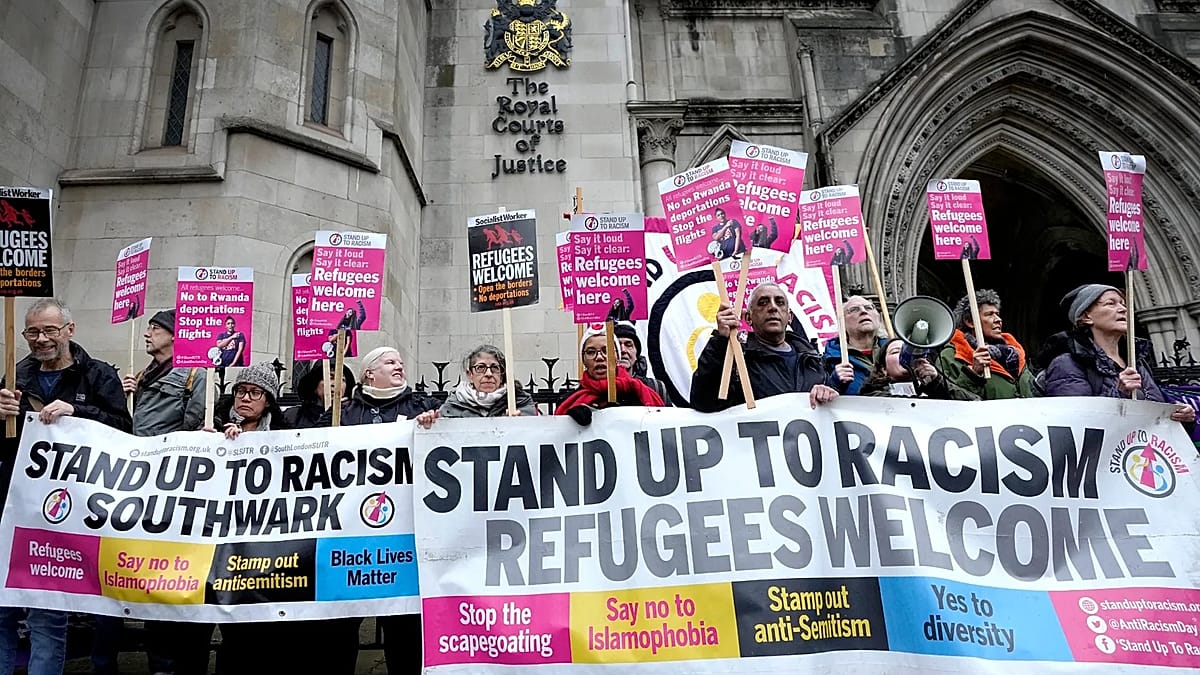
Rwanda has initiated arbitration against the UK after London refused to disburse remaining payments under a controversial 2022 migrant resettlement deal, claiming the UK owes a further £50m after already receiving £240m. The agreement—scrapped by Prime Minister Keir Starmer in July 2024 and earlier ruled illegal under international law by the UK Supreme Court in November 2023—saw virtually no transfers (four voluntary resettlements). The dispute creates a contingent legal and fiscal exposure for the UK government and may yield an arbitration award or settlement risk, but it is unlikely to be broadly market-moving outside of reputational and sovereign-contract risk considerations.
Market-structure: This is a politically-driven, low‑value fiscal dispute (£50m contested, £240m already paid) with asymmetric winners — UK-listed border/security contractors (e.g., Serco SRP.L, Mitie MTO.L) who could capture incremental contract spend if Westminster re‑outsources removals, and law firms/insurers that pick up arbitration work. Direct market-share shifts are small but concentrated: a 1–3% reallocation of Home Office contract spend toward private operators could lift mid‑cap revenues by ~5–15% over 12 months. Cross‑asset effect will be modest: short-term GBP volatility and outperformance of UK small‑cap defensives vs global peers; gilts impact negligible unless dispute broadens.
Risk assessment: Tail risks include an adverse tribunal award setting precedent for state‑to‑state claims (low probability, high reputational cost); an intermediate risk is a UK political backlash that triggers spending on border security (+/- £100–300m range) within 6–18 months. Immediate (days) risk: headline-driven GBP moves of 0.5–1%; short term (weeks/months): elevated volatility around arbitration filings/rulings; long term (quarters/years): policy shifts that reallocate procurement. Hidden dependencies: public-opinion swings before local elections could accelerate contracting; insurance provisions and indemnities in existing contracts matter.
Trade implications: Tactical longs: selective 2–3% position in Serco (SRP.L) and 1–2% in Mitie (MTO.L) sized for 3–12 month horizon, target +15–25%, stop-loss 8%. Hedge: buy a 1–3 month EUR/GBP 1% OTM call (short GBP) sized 0.5% NAV to capture 0.5–2% GBP downside on headline risk. Defensive tactic: trim 2–4% exposure to FTSE 250/index‑exposed UK small‑cap ETFs and reallocate to global industrials until political clarity (reassess in 3 months).
Contrarian angles: Consensus treats this as noise; missing is that repeated legal arbitration wins for smaller states could spur demand for political‑risk insurance and UK legal services — an underowned niche. Reaction may be overdone in small‑cap consumer names but underdone for listed contract managers who get direct renegotiation opportunities; historical parallels: privatized border contracts (post‑migration shocks 2010–2015) led to 20–40% rerating over 6–12 months. Unintended consequence: aggressive short‑GBP bets could backfire if Starmer wins political capital and commits to tougher enforcement, strengthening GBP and contractor revenues simultaneously.
AI-powered research, real-time alerts, and portfolio analytics for institutional investors.
Request DemoOverall Sentiment
moderately negative
Sentiment Score
-0.30
