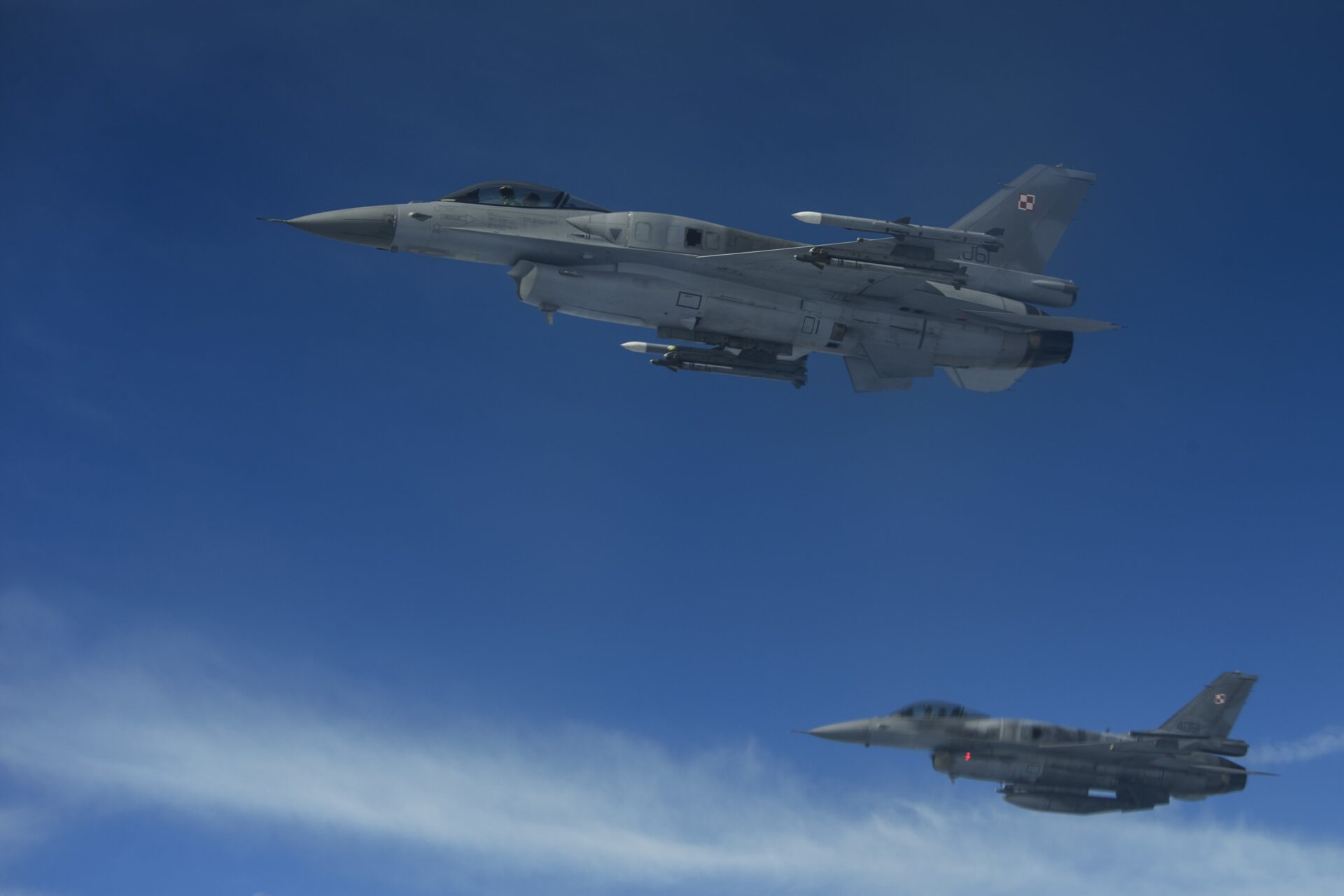
Poland has confirmed that a Polish missile, fired during an F-16 interception of Russian drones over its airspace, caused damage to a residential property, underscoring the escalating risk of spillover from the Ukraine conflict. This incident has prompted Poland to advocate for a no-fly zone over Ukraine and led NATO to launch Operation Eastern Sentry, deploying multinational air defense assets to reinforce Poland's eastern border, indicating heightened regional instability and increased defense posture.
A Polish air-to-air missile, likely an AIM-120 AMRAAM fired from a Polish F-16, inadvertently struck a residential building in Poland while intercepting one of approximately 20 Russian drones that had breached its airspace. This incident, part of Poland's 'Operation Eastern Aurora' air defense mission, underscores the material risk of the Ukraine conflict spilling over into NATO territory. The event has triggered two significant responses: a tangible military escalation and a domestic political dispute. Internationally, it prompted Poland to call for a NATO-enforced no-fly zone over Ukraine and led to the immediate launch of NATO's 'Operation Eastern Sentry,' which involves the deployment of German, UK, French, and Danish fighter jets to reinforce the alliance's eastern flank. Domestically, the incident has created friction within Warsaw, with the President's National Security Bureau and the government offering conflicting accounts over the timeline and content of classified briefings. While the Prime Minister maintains Russia holds ultimate responsibility for the provocation, the internal discord highlights potential challenges in Poland's crisis-response coordination.
AI-powered research, real-time alerts, and portfolio analytics for institutional investors.
Request DemoOverall Sentiment
moderately negative
Sentiment Score
-0.40
