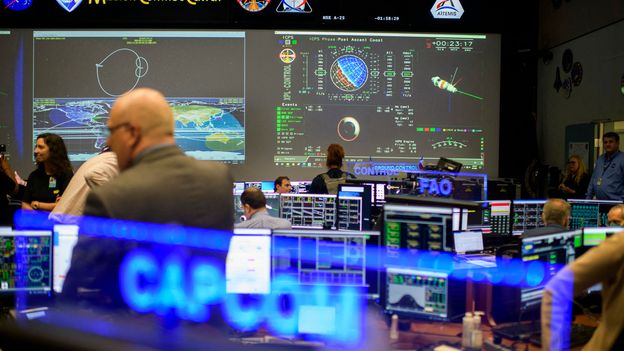
Artemis II is scheduled for launch in April 2026 and will carry four astronauts on a roughly 10-day translunar loop aboard SLS and the Orion capsule; a key mission decision is the day‑2 translunar injection and the crew will be out of contact for ~40 minutes when Orion passes behind the Moon. Mission operations are centralized in NASA's modern Houston mission control with nine flight directors plus an Orion Mission Evaluation Room staffed by the spacecraft designers (including ESA/Airbus for the service module) to monitor and resolve anomalies. Reentry remains a critical risk (reentry speed ~25,000 mph and peak temperatures >2,000°C); Artemis I heat‑shield damage contributed to delays, but operational simulations aim to mitigate failures—overall this is programmatic/operational news with negligible market impact.
Modernizing mission operations is not just a technology refresh—it shifts where value accrues across the aerospace ecosystem. Firms that provide hardened, certified ground systems, simulation software and long-term sustainment services will see more predictable, contractually-backed revenue versus one-off launch vendors; that should compress cyclicality and increase margin visibility for those suppliers over a 6–36 month horizon.
Qualification-heavy subsystems (thermal protection, human-rated avionics, life‑support integration) raise barriers to entry and favor incumbents with heritage flight hardware and traceable test records. That increases pricing power for a small set of suppliers but also concentrates schedule and reputational risk: a single failure or requalification event can force multi-quarter delays and downstream cash‑flow hits across integrators and their subcontractors.
Operational doctrine changes—more simulation, multi‑shift monitoring and mission engineering in the loop—create recurring demand for high‑fidelity simulators, secure comms and mission analytics software. Expect steady, higher‑margin services work for systems integrators and niche software vendors, while capital‑intensive rocket assemblers remain exposed to lumpier milestone payments and execution risk.
Policy and funding are the largest exogenous variables: stable multi‑year procurement budgets sustain the incumbents’ premium, whereas political re‑prioritization or cost overruns shift program winners to lower‑execution-risk contractors. The asymmetric payoff profile favors selective conviction in defense‑grade suppliers with diversified government backlogs rather than single‑program commercial plays; time windows to trade around are upcoming test and qualification milestones over the next 6–24 months.
AI-powered research, real-time alerts, and portfolio analytics for institutional investors.
Request DemoOverall Sentiment
neutral
Sentiment Score
0.00
