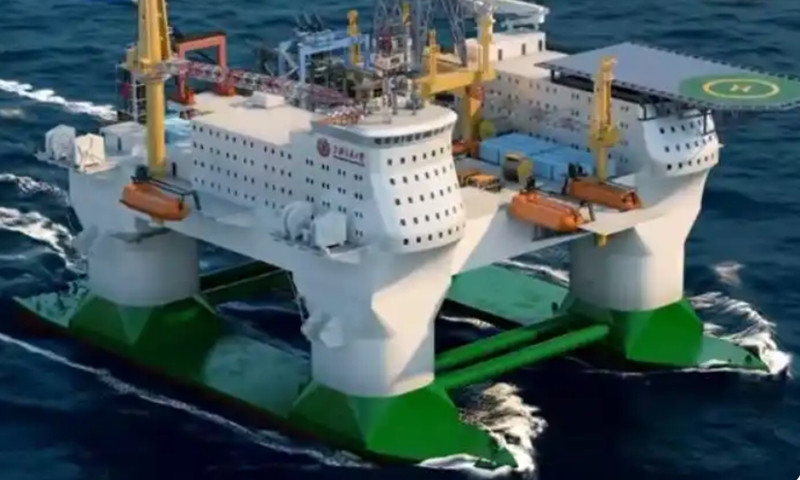
Shanghai launched the 'Open-Sea Floating Island', the world’s first ultra-large marine research platform designed for full-ocean-depth testing to 10,000 meters and handling equipment weighing hundreds of tons; completion is expected in 2030. The facility will serve as an open-sea testbed for deep-sea mining systems, critical marine equipment and offshore oil & gas infrastructure, and aims to accelerate commercialization of marine resources while improving ecosystem monitoring and typhoon forecasting. The project is led by Shanghai Jiao Tong University, which also opened an institute for deep sea science and engineering.
Centralizing high-fidelity deep-sea testing capacity restructures the subsea capital cycle: OEMs can compress R&D timelines and reduce prototype churn, which should raise effective barriers to entry for small specialist vendors and increase bargaining power for large system integrators that secure prioritized test slots. Over a multi-year horizon, that dynamic favors firms with modular product lines and balance-sheet capacity to underwrite long lead-time projects; expect per-project margin uplift of 200–500bps for winners able to scale testing throughput.
A concentrated national facility also creates a non-linear regulatory and geopolitical single point of friction — access policies, export-control reciprocity, or environmental litigation can produce stall-risk clusters that ripple through global supply chains for high-strength steels, subsea electronics, and deep-sea-rated power systems. These are event risks measurable in quarters (permitting disputes) and years (trade policy), so revenue optionality from accelerated commercialization of seabed resources is skewed to the upside but with fat left tails.
From a commodity view, accelerated qualification of seabed extraction systems materially shortens the timeline for marginal increases in nodular manganese/cobalt supply, but not enough to move global battery-metal balances in the next 5 years; the real second-order effect is on capital intensity of miners and a longer-term pressure on juniors’ risk premia. For macro traders, the combination of concentrated capex and sovereign backing increases demand visibility for specialized shipbuilding, heavy-lift modules, and subsea electrification equipment over a 3–7 year window, creating tradeable asymmetries between integrated engineers and small-cap tooling vendors.
AI-powered research, real-time alerts, and portfolio analytics for institutional investors.
Request DemoOverall Sentiment
mildly positive
Sentiment Score
0.25
