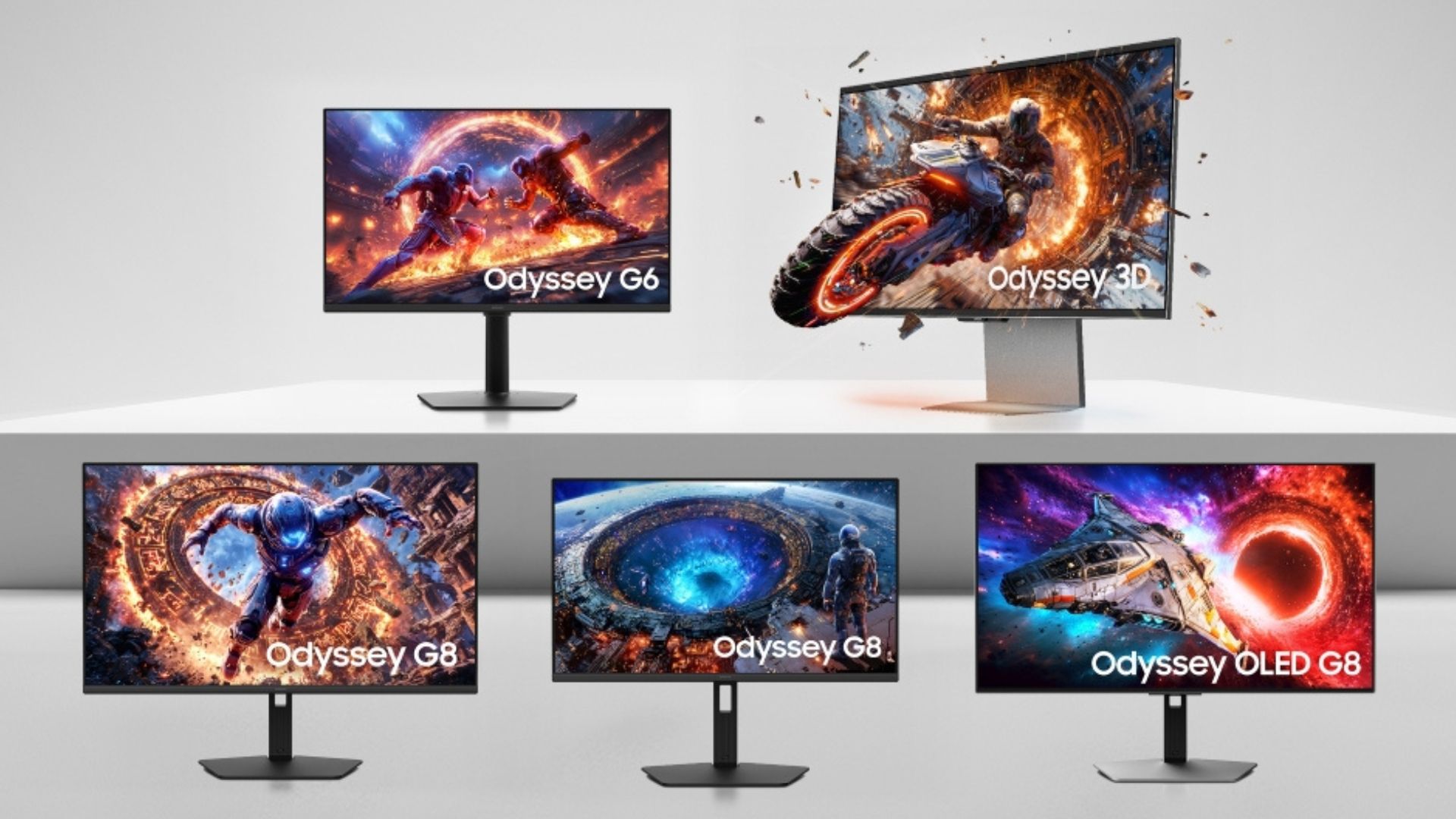
Samsung unveiled five high-end gaming monitors to be shown at CES 2026, led by a 32" Odyssey 3D (G90XH) glasses-free 6K (6144x3456) IPS panel with eye-tracking, native 165 Hz and a dual-mode 3K/330 Hz option. The lineup also includes a 27" Odyssey G6 (G60H) QHD panel with a stated 600 Hz native mode and an asserted 1040 Hz dual-mode at lower resolution (spec ambiguity noted whether that is 1080p or 720p), plus multiple Odyssey G8 variants including a 32" QD-OLED 4K 240 Hz model; all feature modern ports (HDMI2.1/DP2.1) and premium gaming features. Pricing and availability were not disclosed; the products target the premium gaming segment and could modestly support Samsung’s high-end display revenue trajectory but are unlikely to be material near-term market movers.
Market structure: Samsung’s premium Odyssey line structurally raises demand for top-tier GPUs and advanced panel components; clear winners are Nvidia (NVDA) and AMD (AMD) for GPU compute and upscaling tech, and panel/OEM suppliers with DP2.1/QD‑OLED capacity. Higher ASPs at the top-end give Samsung pricing power but likely keep unit volumes niche (expect <5–10% incremental addressable monitor market penetration in first 12 months). Mid/low-end monitor makers and mass-market refresh cycles face downward pressure as R&D shifts to high-margin premium units.
Risk assessment: Tail risks include execution/quality failures (glasses‑free 3D or 1,040Hz claims fail validation) and component bottlenecks (DP2.1 controllers, QD‑OLED wafers) that could force delays or warranty costs; probability moderate, impact high. Timing: immediate (days) — low market moves until CES reviews; short-term (weeks–months) — volatility around preorders and GPU announcements; long-term (1–3 years) — potential materially higher GPU ASPs if adoption scales. Hidden dependency: meaningful TAM hinges on game developers and DLSS/FSR upscaling adoption, not just hardware specs.
Trade implications: Favor semiconductor exposure — overweight NVDA (larger share of high-end GPUs) and tactical AMD exposure (smaller capture of discrete GPU upside). Use options to express convexity into GPU product cycles around CES (7–21 days) and mid‑2026 launches. Rotate from consumer discretionary retailers with high inventory risk (risk of deep discounts post‑CES) into semiconductor equipment and display substrate suppliers over 3–12 months.
Contrarian angle: Consensus assumes straightforward GPU halo-sales; that’s likely overstated — upscaling/AI could negate linear GPU demand for native 6K/1,000Hz. Historical parallel: 4K monitor upgrade cycle took ~3–4 years to reach material volumes; expect similarly slow unit growth here. Mispricing risk: NVDA upside is underpriced for secular AI/GPU exposure, but premium monitor impact on overall GPU TAM is likely under 15% in first 12 months, so avoid overlevering on monitor-driven thesis.
AI-powered research, real-time alerts, and portfolio analytics for institutional investors.
Request DemoOverall Sentiment
mildly positive
Sentiment Score
0.25
Ticker Sentiment
