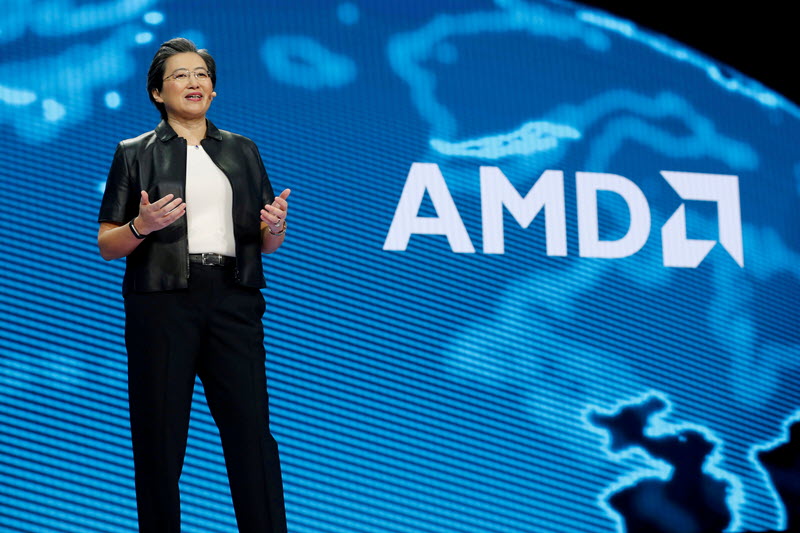
AMD CEO Lisa Su met with Chinese Vice Premier He Lifeng in Beijing, where China invited the company to deepen cooperation as U.S.-China trade relations showed signs of stabilization. He said the two countries’ trade teams reached 'overall balanced and positive outcomes,' suggesting improved bilateral certainty. The article is largely diplomatic and does not include any earnings, guidance, or financial metrics, so near-term market impact appears limited.
The incremental signal here is not about near-term demand for AMD hardware so much as policy de-risking. A softer bilateral tone lowers the probability of abrupt export-control escalation, which is the real beta driver for semis exposed to China even when direct revenue exposure is modest. That should compress the “headline discount” embedded in valuation multiples for AMD relative to the broader AI complex, because the market has been paying up for names with cleaner geopolitical optionality rather than pure operating improvement.
Second-order beneficiaries are likely the supply chain names with China exposure that have been treated as one-way tariff/geopolitics leverage. If the thaw persists, memory, PCB, substrate, and outsourced assembly/test vendors can see faster multiple expansion than AMD itself because they are more cyclical and more discounted. The more interesting effect is on inventory behavior: customers that had been ordering defensively can extend lead times again, which helps gross margin stability across the chain over the next 1-2 quarters.
The contrarian risk is that this is more of a diplomatic reset than a policy reset. Even with improved tone, the U.S. still has clear incentives to keep advanced semiconductor controls intact, so the upside to AMD is likely capped unless there is evidence of licensing or product-specific carveouts. In other words, the move is probably underpriced for sentiment, but over-expected if investors are hoping for a real loosening of restrictions.
Time horizon matters: over days, this is a sentiment/multiple trade; over months, it only becomes fundamental if China-linked revenue and channel confidence improve without a corresponding tightening elsewhere in the export regime. The biggest reversal catalyst would be any renewal of tariff rhetoric or a new enforcement action aimed at AI compute supply chains, which would quickly reintroduce the geopolitical discount.
AI-powered research, real-time alerts, and portfolio analytics for institutional investors.
Request DemoOverall Sentiment
neutral
Sentiment Score
0.15
Ticker Sentiment
