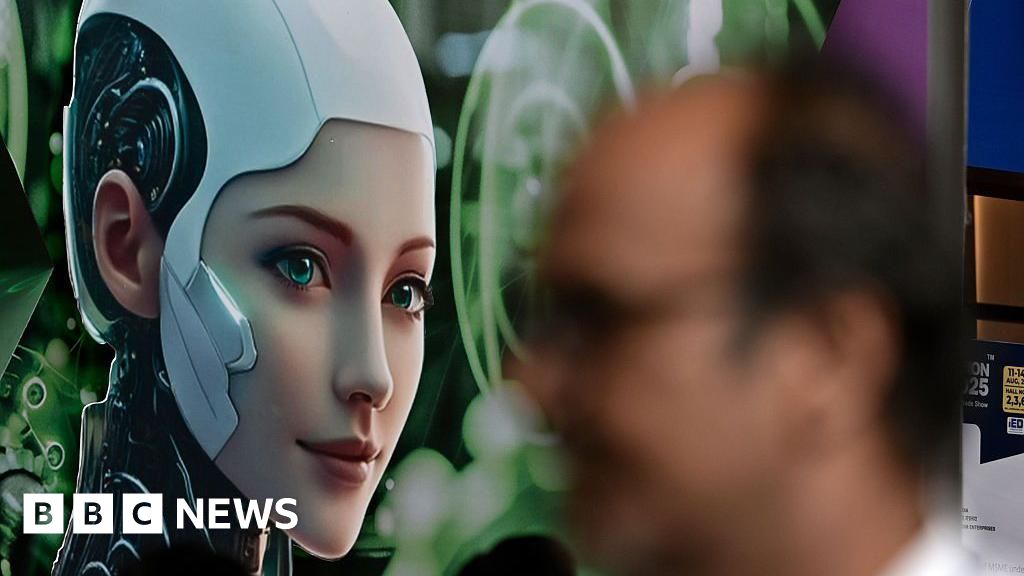
Amazon and Microsoft pledged a combined more than $50bn of investment in India—Microsoft $17.5bn and Amazon over $35bn—aiming to build AI infrastructure, skills and sovereign capabilities, a timely boost after foreign capital favoured Korea and Taiwan and as brokers frame India as a hedge against an overheated global AI trade. Yet India still lags on core inputs: limited compute and semiconductor capacity, fragmented data ecosystems, weak long-term R&D funding and talent retention (its $1.25bn sovereign AI mission is tiny versus France’s $117bn or Saudi Arabia’s $100bn), even as the country ranks among the top five for new AI companies and accounts for 9.2% of AI publications. The practical opportunity lies in downstream adoption—AI-powered consumer and public-sector apps such as MahaVISTAAR (15m farmers reached)—but converting headline investments into global-model leadership requires policy incentives, infrastructure scale-up and mitigation of disruption to India’s large IT services sector.
Microsoft and Amazon announced combined commitments exceeding $50 billion to India—Microsoft $17.5 billion and Amazon over $35 billion (through 2030)—explicitly targeting AI infrastructure, skills and sovereign capabilities; brokers such as Jefferies and HSBC frame these commitments as a timely positive for Indian equities, which have lagged as foreign capital flowed into Korean and Taiwanese AI leaders.
Structural gaps remain material: India’s $1.25 billion sovereign AI mission is dwarfed by France’s $117 billion and Saudi Arabia’s $100 billion programs, domestic compute and semiconductor capacity are limited, and talent retention is unresolved despite a 2.5x higher concentration of AI-skilled professionals versus the global average. Notable progress includes Intel’s collaboration with Tata Electronics and an imminent multi‑language sovereign model, but private funding is still small—74 new AI startups raised $1.16 billion last year versus over $100 billion in the US and nearly $10 billion in China.
The announcements de-risk parts of the infrastructure and downstream adoption runway, supporting growth in AI-powered consumer and public-sector apps (e.g., MahaVISTAAR reaching 15 million farmers), yet execution, policy incentives and scale are critical. Risks include disruption to India’s large IT services sector—Jefferies flags slowing back‑office growth and hiring—and a durable outperformance depends on converting capex into domestic R&D, talent attraction and cohesive data ecosystems.
AI-powered research, real-time alerts, and portfolio analytics for institutional investors.
Request DemoOverall Sentiment
mixed
Sentiment Score
0.12
Ticker Sentiment
