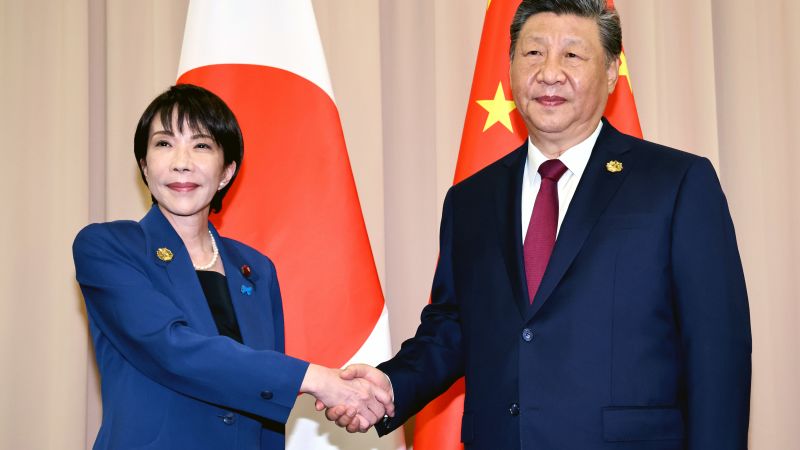
Japan’s new prime minister Sanae Takaichi’s suggestion that Tokyo could use military force if China tried to seize Taiwan has provoked a calibrated backlash from Beijing — travel and study warnings, threats to Japanese exports, sustained nationalist media and military rhetoric — and a diplomatic standoff that has lasted about two weeks. The dispute highlights Beijing’s acute sensitivity to a shifting regional military balance as Japan moves away from post‑war pacifism toward higher defense spending, closer U.S. coordination and possible constitutional changes, with historical grievances amplifying Chinese domestic mobilization. For investors and policymakers, the episode signals Beijing’s willingness to blend economic pressure and political signaling to deter Japanese and regional policy shifts on Taiwan, raising the risk of sustained tensions that could complicate defense cooperation and cross‑border trade ties.
Japan’s new prime minister Sanae Takaichi’s statement that Tokyo could respond militarily if China used force against Taiwan has produced a calibrated Beijing backlash lasting roughly two weeks, including travel and student warnings, threats to Japanese seafood exports, amplified state-media denunciations and military-themed social-media content such as a video titled “Don’t be too cocky.” The Communist Party mouthpiece People’s Daily framed the comments as an unprecedented Japanese military threat and Chinese state commentary and viral imagery have been used to signal domestic resolve and to pressure Tokyo to retract the remarks.
The spat sits against a backdrop of Japan’s recent security pivot — higher defense spending, acquisition of counterstrike capabilities, closer U.S. ties and debate over constitutional change — which Beijing views as directly challenging its Taiwan-related ambitions; historical grievances (including repeated references to the Nanjing Massacre and World War II anniversaries) have intensified nationalist mobilization on both sides. Observers cited in the article characterize Beijing’s response as aimed at “boxing in” Takaichi politically and deterring further Japanese moves on defense policy.
Market implications are directional rather than systemic: the report highlights targeted economic coercion risk to sector exposures tied to China–Japan flows (travel, education, seafood and export-facing industries), while sentiment metrics show moderately negative market tone (sentiment score -0.45) with ETF-level weakness signalled for Japan (EWJ -0.5) and Taiwan (EWT -0.6) and smaller negative pressure on China large-caps (FXI -0.2); the market_impact_score of 0.35 suggests elevated geopolitical risk with limited immediate contagion but asymmetric tail risk if the standoff escalates or expands.
AI-powered research, real-time alerts, and portfolio analytics for institutional investors.
Request DemoOverall Sentiment
moderately negative
Sentiment Score
-0.45
Ticker Sentiment
