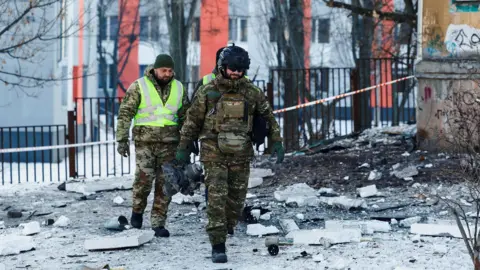
Renewed Russian strikes have badly damaged Ukraine's energy infrastructure — including Kyiv's Darnytsia CHP and a Kharkiv power plant — leaving more than 1,100 apartment buildings in Kyiv without power and prompting over 200 repair crews amid temperatures near -20C. The attacks (including 100+ drone strikes and cluster munitions) have caused multiple casualties — e.g., seven killed in Druzhkivka — and increase downside risk to regional energy supply, humanitarian conditions and defense-related assets, while trilateral peace talks in Abu Dhabi show limited prospect of immediate de-escalation.
Market structure: Energy-infrastructure repair, residential backup power (gensets) and western defense suppliers are immediate beneficiaries while Ukrainian assets, regional banks and energy-intensive European industry are direct losers; expect European TTF gas and day-ahead power spreads to show 15–40% episodic spikes over weeks if attacks on generation persist. Competitive dynamics favor large, vertically integrated utilities and OEMs with spare-parts and logistics scale (CAT, GNRC, RWE/EOAN) able to capture emergency margins; smaller regional suppliers and insurers will see pricing power weaken and higher claim frequencies. Cross-asset: expect safe-haven flows into USD, gold and USTs (10y yield down ~10–30bps in acute shock), widening CDS on Ukrainian and nearby sovereigns, and higher volatility in energy and FX (UAH weakness vs USD by 10–30% in stress scenarios).
Risk assessment: Tail risks include escalation (NATO involvement or broader strikes on EU energy nodes) or Russia cutting gas exports to Europe—both could trigger >50% moves in regional gas prices and a multi-quarter inflationary shock. Time horizons: days—localized volatility and intraday power-price spikes; weeks–months—sustained higher energy prices and defense orders; quarters–years—reconstruction capex in grid, heavy machinery and cybersecurity for critical infrastructure. Hidden dependencies: European storage levels, LNG cargo availability and temperature volatility (a prolonged cold spell >2 SD below seasonal averages would amplify stress). Catalysts: failed/advanced peace talks, additional sanctions, or major pipeline outages will accelerate moves; successful de-escalation could reverse within 4–8 weeks.
Trade implications: Favor tactical longs in backup-generator and defense suppliers and short/hedge eastern-European sovereigns and energy-intensive cyclicals. Use options to express short-term volatility (VIX/energy) and keep directional commodity exposure via gas futures or ETFs rather than pure equities to avoid idiosyncratic operational risk. Rotate 2–5% of portfolios from small-cap/EM Europe into AAA-duration and inflation-protected securities while maintaining a 1–3% volatility hedge.
Contrarian angles: Consensus focuses on outright defense longs and commodities; underappreciated is the multi-year revenue stream for grid-rebuild and spare-parts suppliers—capex winners can compound for 12–36 months (engineering firms, specialty transformers, control-systems). The market may overprice immediate gas scarcity—if EU storage remains >70% into March and LNG arrivals stay steady, a 20–30% mean reversion in TTF/UNG is plausible; consider staggered entries and delta-hedged option structures to capture both spikes and reversion.
AI-powered research, real-time alerts, and portfolio analytics for institutional investors.
Request DemoOverall Sentiment
moderately negative
Sentiment Score
-0.60
