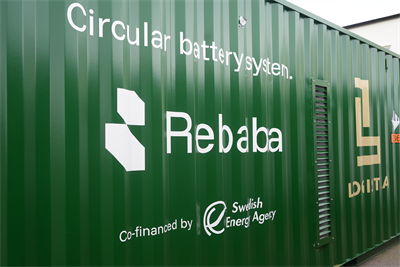
Comsys AB announced the successful installation of a containerized, grid-connected second-life battery system in Borås, Sweden, using its control software and hardware to integrate repurposed EV batteries delivered by Rebaba and assembled with El och Marinteknik. The system operates responsively in real time—able to supply or absorb energy and maintain the 50 Hz frequency balance—demonstrating that reused car batteries can meet reliability and stability requirements for the Nordic grid. Comsys says the project proves a fully Swedish, scalable battery energy storage solution can be built without original carmaker involvement, extending battery life, reducing waste and potentially creating new commercial opportunities for BESS integrators and grid operators in the region.
Comsys AB announced the successful installation of a containerized second-life battery system in Borås, Sweden, with Comsys control software and hardware at its core; the system was delivered by Rebaba and integrated by El och Marinteknik using repurposed electric vehicle batteries. The installation is grid-connected and designed to operate in real time to either supply or absorb energy while maintaining the 50 Hz frequency balance required by the Nordic grid, demonstrating functional stability and responsiveness for second-life assets.
The company highlights that the project is fully Swedish and scalable and explicitly notes it was built "without the involvement of the original car manufacturer," signaling a potential open value chain for BESS integrators using reused cells. That technical validation addresses two investor-relevant points: operational suitability for ancillary services and a pathway to extend battery life while lowering material waste.
Strategic implications include potential new commercial opportunities for BESS integrators, grid operators and circular energy providers in the Nordics, and an ESG/cost angle from extended asset life. Key risks remain unquantified in the release: long-term performance and degradation of second-life packs, economic competitiveness versus new batteries, standardization and regulatory acceptance at scale.
AI-powered research, real-time alerts, and portfolio analytics for institutional investors.
Overall Sentiment
mildly positive
Sentiment Score
0.30
