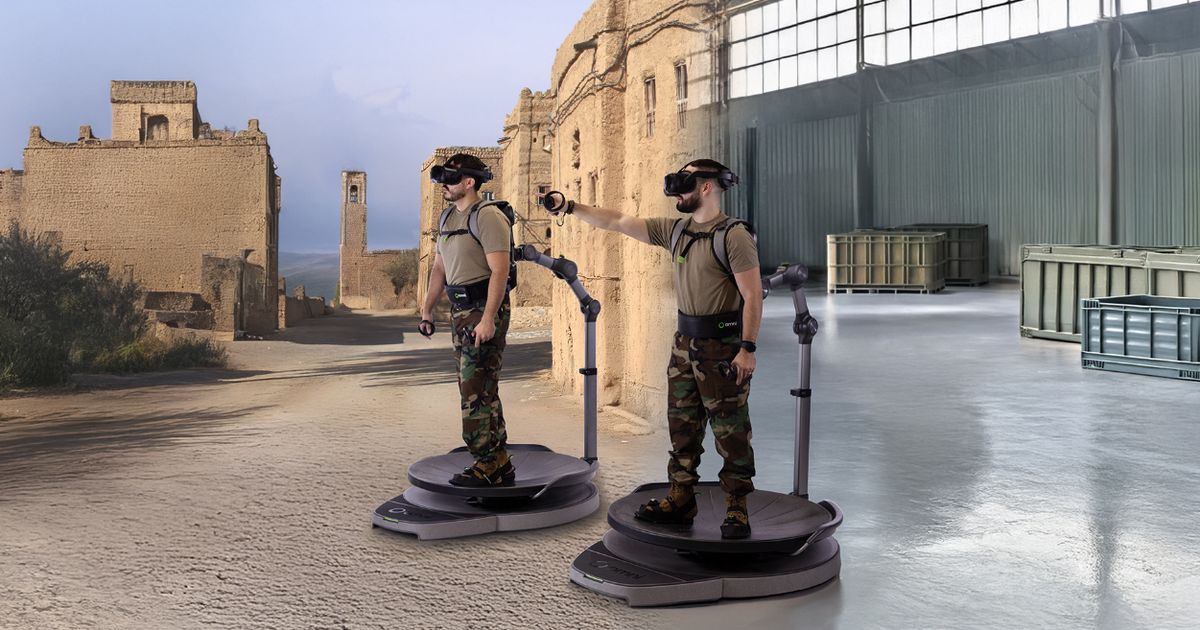
Virtuix (NASDAQ:VTIX) has integrated AI-driven Gaussian splatting into its Virtual Terrain Walk platform, enabling conversion of 360° captures into photorealistic, navigable 3D environments in hours rather than weeks and pairing those environments with its omni‑directional treadmills for multi-user ground-combat rehearsal. The company demonstrated a proof of concept at I/ITSEC with partners Cesium (Bentley) and HTC, reports early Omni One test unit purchases by Yokota AFB, the US Air Force Academy and West Point, and says it will balance potential consumer Omni One volume with higher‑margin enterprise and defense recurring software licensing and custom simulation work.
Winners are niche VR-simulation software and geospatial stacks (Virtuix/VTIX, Cesium/Bentley BSY) and integrators selling recurring-license models; losers are manual terrain-modeling consultancies and legacy content shops that charge weeks of labor. Faster AI reconstruction compresses content creation costs (potentially >5x throughput improvement vs historical workflows), increasing supply of geo-specific simulations and pressuring prices for bespoke modeling but expanding addressable demand from bases, academies and enterprise safety training.
Competition will bifurcate: horizontally scalable software/geospatial providers gain pricing power via SaaS/recurring licenses while hardware vendors (omni-treadmills, headsets) remain volume-sensitive; larger primes (LMT/RTX/GD) may be buyers/partners rather than direct victims, changing procurement dynamics and accelerating outsourcing of non-core simulation work. Cross-asset: modest positive for A&D credit (improved efficiency in training budgets), limited FX effects; small-cap vol (VTIX) likely stays elevated—expect equity options skew to the upside for winners.
Tail risks include export/regulatory controls on geospatial/AI imagery, classification/security hurdles for real-world scans, and integration failures—any of which could delay contracts by 6–18 months. Near-term (days–weeks) reaction will be sentiment-driven; short-term (3–12 months) driven by pilot orders and trade-show proofs; long-term (12–36 months) depends on recurring revenue adoption and defense procurement cycles. Key catalysts: DoD pilot awards, USAF/Army contracts, and inclusion in base curricula within 3–9 months.
Consensus underestimates adoption frictions (security, bandwidth, IP) and overestimates immediate margin capture; software can be commoditized rapidly, capping long-term margins if competition multiplies. Historical parallel: early GIS companies saw rapid uptake but thin margins until enterprise recurring contracts formed; unintended consequence is primes bundling simulation to protect service revenue, limiting pure-play re-ratings.
AI-powered research, real-time alerts, and portfolio analytics for institutional investors.
Request DemoOverall Sentiment
mildly positive
Sentiment Score
0.32
Ticker Sentiment
