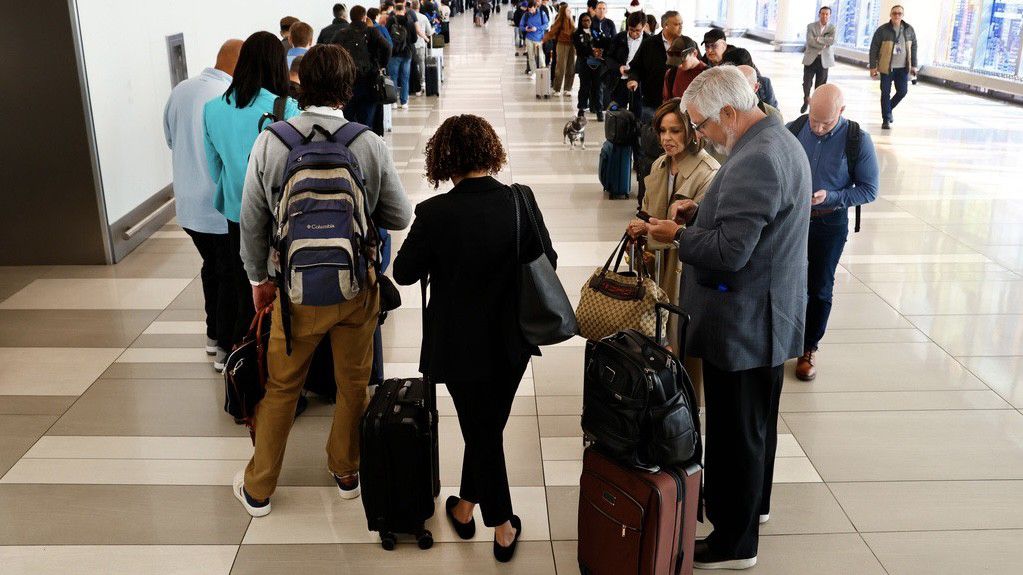
Shutdown Day 41: more than 11% of TSA employees on the schedule missed work (over 3,120 callouts), nearly 500 of ~50,000 officers have quit, and multiple airports report >40% callout rates, with TSA workers facing a second missed payday. President Trump said he will sign an order directing DHS to immediately pay TSA agents — potentially via a national emergency or by shifting funds — a step likely to prompt legal challenges. The staffing crisis is causing substantial travel delays and raises the near-term risk of airport closures, posing sector-level pressure on airlines, airports and travel services.
Operational friction at major airports acts like a transient supply shock to the travel ecosystem — fewer boards and slower throughput amplify per-flight idling costs (crew, fuel burn, slot opportunity loss) and compress ancillary revenue (bag fees, change fees, onboard sales) disproportionately versus fixed-cost capacity. If disruptions persist for weeks, expect carriers with lower liquidity and higher short-term lease exposure to see EBITDA hits in the high-single-digit percentage range for the affected quarter, while better-capitalized peers use schedule rationalization to protect margins.
A federal executive maneuver to keep frontline staffing solvent creates a high-probability legal and political timeline measured in months: courts can enjoin actions quickly but settlements or legislative fixes take longer. That dynamic benefits companies that can monetize contingency spending (security contractors, screening tech vendors) on a 3–12 month basis, but it also raises reputational and contracting counterparty risk for firms with deep DHS exposure should litigation or oversight follow.
Behavioral substitution is an immediate second-order channel: consumers facing airport disruption shift to drive/short-haul rail and local lodging, lifting car rental and airport-proximate hotel occupancy for short windows while reducing OTA revenue capture from cancelled/voided bookings. That rotation is concentrated and short-dated — expect a 2–6 week window where regional transport and select lodging names outperform flight-centric equities.
Market pricing is likely to overshoot on headline risk; a bipartisan stopgap or a court stay could rapidly reverse losses. Tradeable windows are therefore asymmetric: buy downside protection to capture headline-driven moves, but be prepared to flip to long exposure on select beaten-down travel names if a legislative resolution appears imminent within 1–4 weeks.
AI-powered research, real-time alerts, and portfolio analytics for institutional investors.
Request DemoOverall Sentiment
moderately negative
Sentiment Score
-0.45
