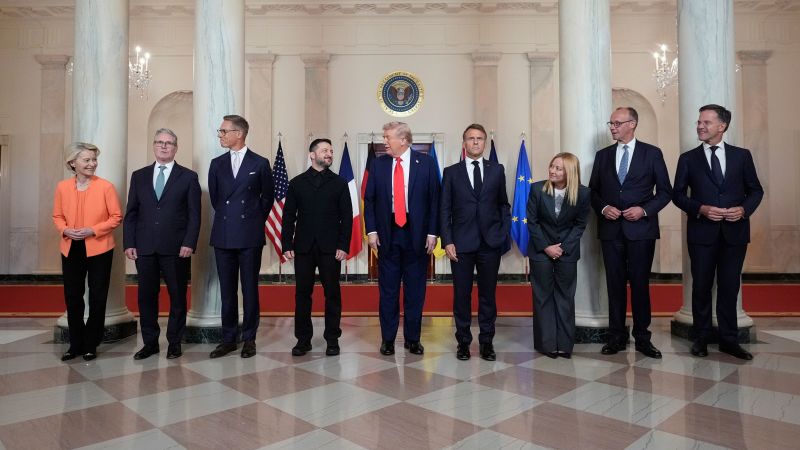
Security guarantees for Ukraine are central to peace discussions, with President Zelensky pushing for robust assurances to deter future Russian aggression. A coalition of allies is exploring options, including a potential 10,000-troop deterrent force and broader air/sea support, but implementation faces significant logistical challenges for European armies. The critical US role remains ambiguous under President Trump, who advocates for European leadership and rejects US ground troops, despite the perceived necessity of US underwriting for Russian acceptance. This complex dynamic, coupled with Russia's vehement rejection of any NATO military presence, poses substantial risks for alliance cohesion and the long-term stability of any peace settlement.
Security guarantees have emerged as the central, and most contentious, element in discussions for a peace settlement in Ukraine. While a "Coalition of the Willing" comprising approximately 30 nations is formulating a plan, its viability is questionable due to immense logistical and political hurdles. Initial concepts for a 30,000-strong contingent have been scaled back to a more feasible 10,000-troop deterrent force, which military analysts from the IISS note would have limited combat capability and serve primarily as a political tripwire. Furthermore, deploying even a credible force of over 100,000 troops along the 1,000-kilometer front line is considered a huge stretch for European armies, which have shrunk since the Cold War. The situation is critically complicated by the ambiguous stance of the United States. President Trump has signaled a departure from previous policy by agreeing to US involvement in coordination, a move seen as a "breakthrough" since Russian acceptance hinges on American underwriting. However, his rejection of US ground troops and insistence on European leadership creates a significant credibility gap and exposes a potential fracture point in the transatlantic alliance. This is set against Russia's unequivocal rejection of any NATO-affiliated troops on Ukrainian soil and its own demands for security limitations on Ukraine's military, creating a diplomatic impasse that grants Moscow a de facto veto over the deployment of any assurance force.
AI-powered research, real-time alerts, and portfolio analytics for institutional investors.
Overall Sentiment
mildly negative
Sentiment Score
-0.35
Ticker Sentiment
