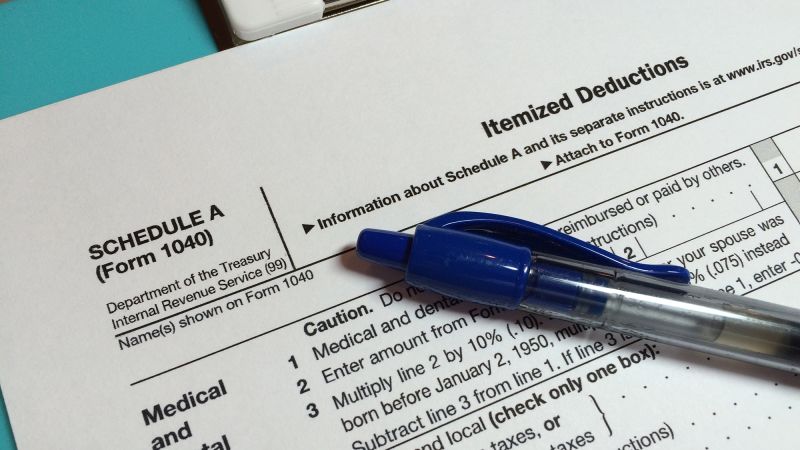
House Republicans are facing internal conflict over raising the $10,000 cap on the state and local tax (SALT) deduction, a key provision of the 2017 Tax Cuts and Jobs Act, as they aim to pass a broader tax bill making individual income tax provisions permanent. While a proposal to raise the cap to $30,000 for taxpayers with incomes below certain thresholds is under consideration, lawmakers from high-tax states are pushing for greater relief, potentially jeopardizing the bill's passage due to revenue concerns, as the current $30,000 cap is projected to raise $915.6 billion over 10 years.
The ongoing debate within House Republicans regarding an increase to the $10,000 State and Local Tax (SALT) deduction cap, established by the 2017 Tax Cuts and Jobs Act (TCJA), presents a significant hurdle to passing broader legislation aimed at making individual income tax provisions permanent. The TCJA's $10,000 cap, combined with an expanded standard deduction, drastically reduced the number of filers claiming the SALT deduction from approximately 25% in 2017 to under 10% currently. A current proposal from House committees suggests raising the cap to $30,000 for taxpayers with modified adjusted gross incomes below $400,000 (joint filers) or $200,000 (single filers); this measure is projected to generate $915.6 billion in revenue over ten years compared to allowing the cap to expire. However, this proposal faces staunch resistance from Republican lawmakers in high-tax states such as California and New York, who advocate for greater relief for their constituents, thereby creating significant intraparty tensions. Historically, the SALT deduction, which dates back to 1913, has disproportionately benefited higher-income individuals in high-tax jurisdictions; for instance, in 2017, prior to the cap, roughly two-thirds of the deduction's benefit accrued to those with incomes exceeding $200,000. The imposition of the cap by the TCJA notably reduced the tax cuts for higher earners, with the top 1% experiencing an average tax cut $30,900 smaller than it would have been without the SALT limitation, while the bottom 80% of taxpayers saw little change.
AI-powered research, real-time alerts, and portfolio analytics for institutional investors.
Overall Sentiment
Neutral
Sentiment Score
-0.10
