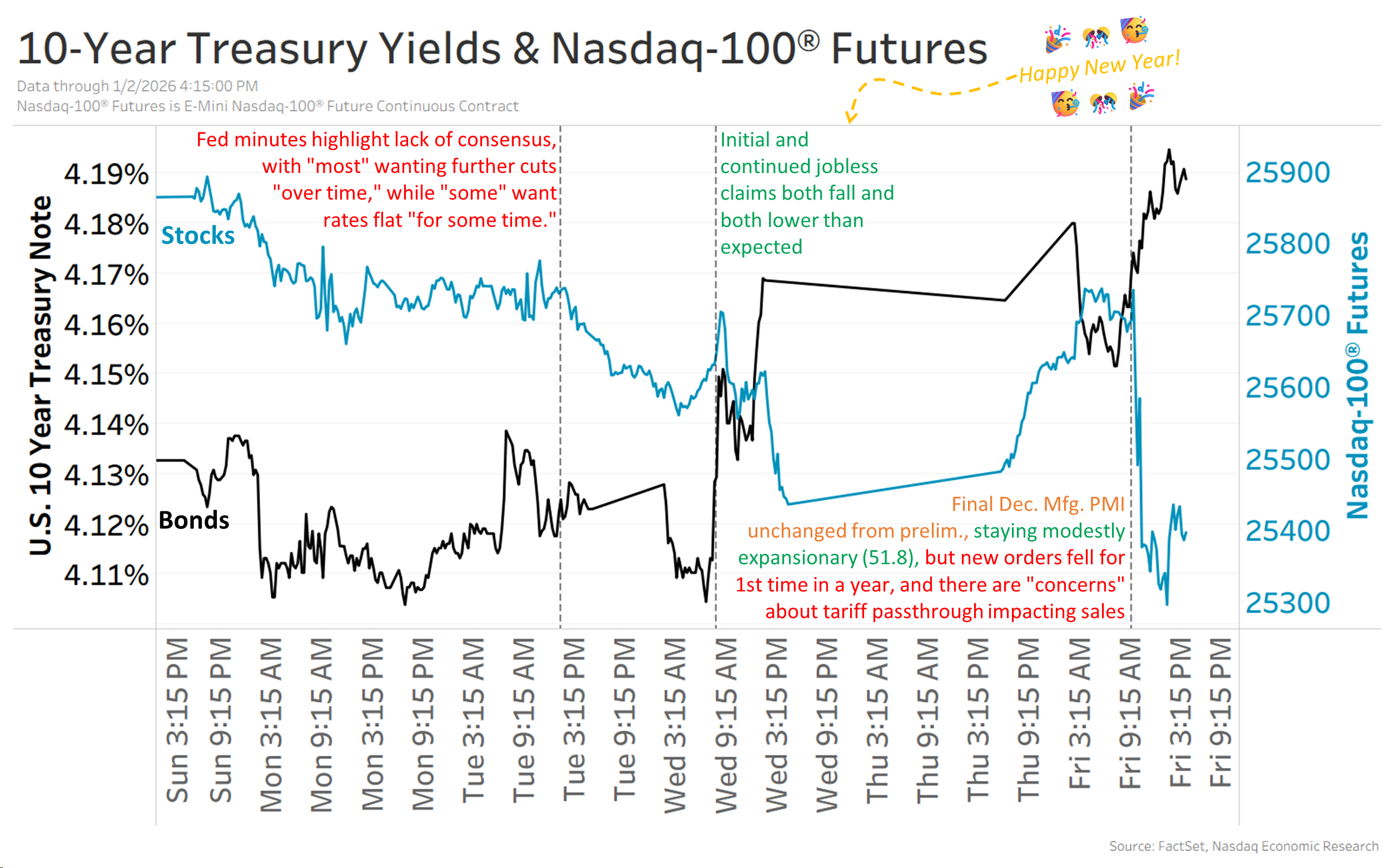
December Fed minutes showed a divided committee but a dovish lean—'most' members supported cutting rates and expect further cuts over time while 'some' favored holding rates flat; policymakers generally expect the labor market to stabilize in 2026 as growth picks up. Market moves were muted: the Nasdaq-100 fell about 2% for the week (still +21% for 2025) and the 10-year Treasury yield rose just over 5 basis points to roughly 4.2%, with reports that layoffs remain low and manufacturers are navigating tariffs.
Market structure: The Fed minutes signal a tilt toward cuts “over time,” not immediate easing, so winners in a delayed-cut scenario are financials (net interest margin support) and short-duration credit; beneficiaries of eventual cuts (6–18 months) are long-duration bonds, REITs, and high-growth tech which have outperformed (Nasdaq +21% YTD). With 10‑yr at 4.20%, cross-asset flows will pivot: a 25–75 bp fall in the 10‑yr would likely compress IG spreads by 10–30 bp and lift long-duration equity multiples 10–20%. Supply/demand: low layoffs and steady consumption argue against a sharp contraction in credit demand, keeping corporate issuance and spreads on a tight leash unless policy surprises occur.
Risk assessment: Key tail risks are (1) a Fed hold or hawkish surprise keeping 10‑yr >4.5% (would inflict 15–30% drawdowns on long-duration growth names), (2) inflation resurgence forcing steeper hikes, and (3) geopolitical/China demand shocks widening credit spreads 50–150 bp. Time horizons matter: days–weeks expect headline-driven volatility around CPI/NFP; 3–12 months expect pricing of one or more cuts if labor cools; 2026 is the Fed’s median stabilization horizon. Hidden dependencies include bank funding dynamics and corporate buyback pacing; catalysts to watch: monthly CPI, nonfarm payrolls, and Fed dot-plot shifts.
Trade implications: In the current regime, implement a barbell: defensive income and tactical rate-sensitive equities. Use options to asymmetrically express a view—buy 6–9 month call spreads on growth to play eventual cuts while funding with short-dated put sales against idiosyncratic names. Relative-value: long regional banks versus short long-duration tech if 10‑yr >4.3% (rates persist), and flip if 10‑yr drops <3.8% (favor growth).
Contrarian angles: Consensus may be underestimating the cost of delayed cuts—markets have priced substantial easing already into long-duration assets; if cuts slip beyond 12 months, multiples compress and flows reverse. Historical parallel: 2018 rapid re-pricing when the Fed surprised to hawkishness produced multi-quarter equity drawdowns despite healthy fundamentals. Unintended consequence: an early liquidity surge into growth after a premature rate-cut narrative could widen dispersion and create attractive short opportunities in overlevered small caps.
AI-powered research, real-time alerts, and portfolio analytics for institutional investors.
Request DemoOverall Sentiment
neutral
Sentiment Score
0.10
