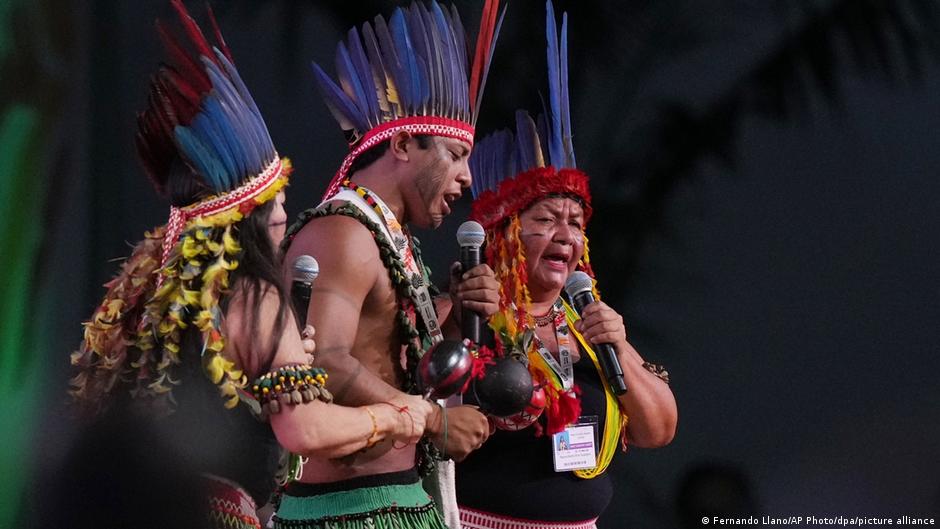
COP30 in Belem is emphasizing the critical role of Indigenous peoples in climate mitigation, whose stewardship of approximately a quarter of the world's land, including vital carbon sinks, is proven to significantly reduce deforestation and emissions. Key developments include pledges by multiple countries to formally recognize 80 million hectares of Indigenous land rights by 2030 and the proposed $125 billion Tropical Forests Forever Facility, earmarking 20% for Indigenous communities. However, while Indigenous participation at COP30 is at a record high, leaders stress the need for direct funding, genuine consultation, and protection, expressing concerns about the practical implementation of these commitments and their limited access to core negotiations, underscoring that effective climate justice hinges on these issues.
COP30 in Belem is emphasizing the critical role of Indigenous peoples in global climate mitigation, adopting "mutirao" (collective effort) as its central theme. Indigenous communities, comprising just 6% of the global population, manage approximately 25% of the world's land and up to half of its intact forests, which are vital carbon sinks storing an estimated 861 gigatons of carbon. Evidence strongly suggests that respecting Indigenous territorial rights significantly reduces deforestation, with one study indicating a potential 66% decrease in the Brazilian Amazon.
Key developments include a pledge by multiple countries to formally recognize 80 million hectares of Indigenous land rights by 2030. Additionally, the proposed $125 billion Tropical Forests Forever Facility (TFFF) aims to allocate 20% of its funds directly to Indigenous communities, recognizing their role as effective stewards of natural resources. These initiatives highlight a growing financial commitment towards Indigenous-led conservation efforts.
However, a "mixed" sentiment and "cautious" tone persist regarding the practical implementation of these pledges, despite record Indigenous participation at COP30. Indigenous leaders stress the necessity of direct and equitable access to funding, genuine consultation for green energy projects, and enhanced protection, citing that roughly one-third of environmental defenders killed in 2024 were Indigenous. Concerns also remain about limited access to core negotiation areas and the efficacy of certain climate mechanisms like carbon credits.
AI-powered research, real-time alerts, and portfolio analytics for institutional investors.
Request DemoOverall Sentiment
mixed
Sentiment Score
0.10
