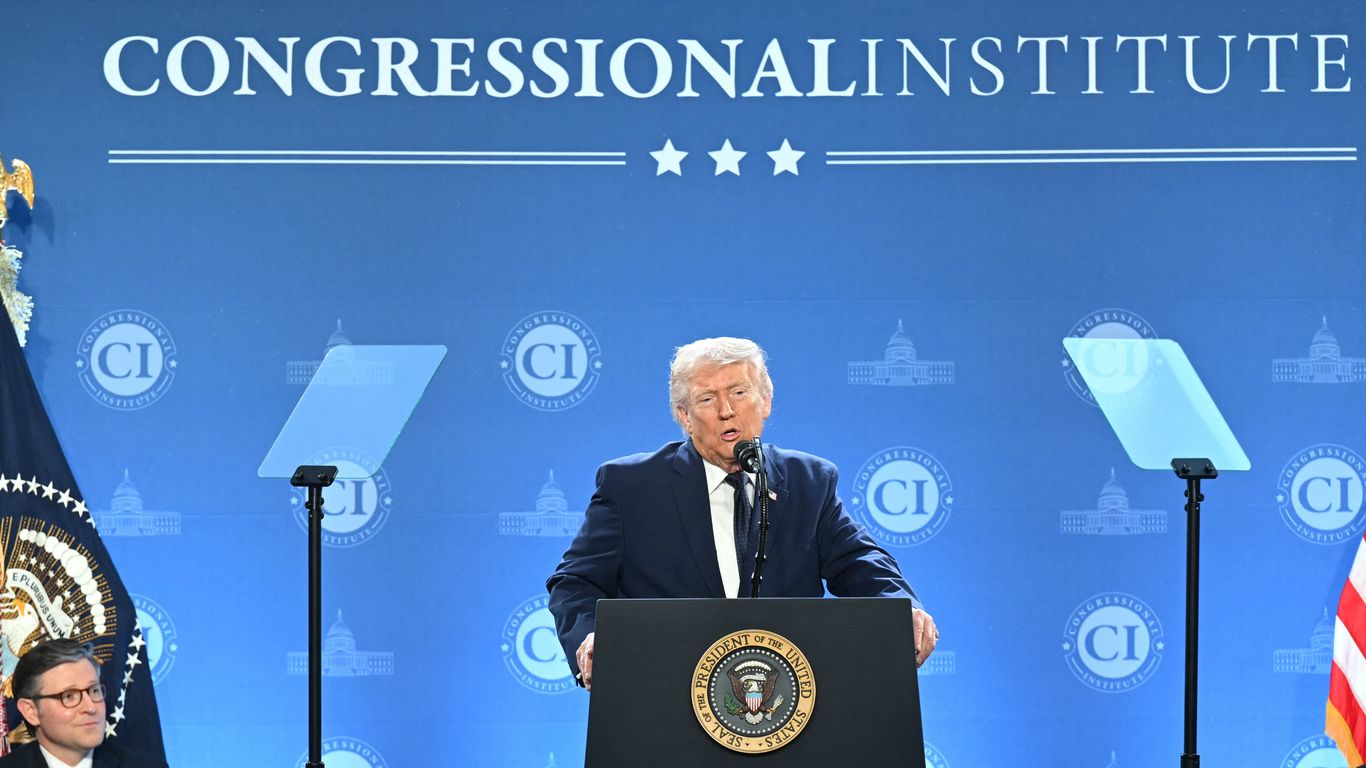
52% of voters view the Democratic Party unfavorably, and Trump advisers are pushing House Republicans to frame the 2026 midterms as a choice election focused on taxes, crime and border security, shifting rhetoric from mass deportations to targeting violent offenders. Panelists highlighted the GOP's fundraising advantage and organizational edge in a small map cycle, while noting structural headwinds: 34 Republicans and 21 Democrats plan to leave the House and Trump's approval remains in the low 40s, which could drag down GOP performance. Historical midterm patterns (Republicans -41 seats in 2018; Democrats -63 in 2010) underscore continued uncertainty for control of the House.
The GOP pivot to a targeted law-and-order and border-enforcement message is effectively a reallocation of political risk rather than a policy sea change: it narrows the subset of immigration- and crime-related interventions that markets need to price. That matters because more focused promises (deport violent offenders, boost local policing, shore up borders) are easier to translate into discrete budget line-items and procurement programs than broad systemic immigration overhauls, shortening the lag between messaging and federal/state contract flows to 6–18 months.
A funding advantage for one party in a small electoral map compresses outcome dispersion — i.e., the market’s tail for a sweeping legislative surprise shrinks, but the probability mass shifts toward incremental, targeted spending in homeland security, detention capacity, and public-safety tech. Second-order winners are those with high revenue sensitivity to federal/state procurement cycles (defense/homeland vendors, corrections contractors, police tech), while broad-based regulatory winners (large banks, big-cap tech) may see only modest policy relief absent unified control.
Key near-term catalysts: PAC cash deployment in Q3–Q4 2025 and state budget cycles that finalize appropriations in 2025–2026; both will reveal whether messaging converts to spend. Tail risks include a sudden reversal in public sentiment tied to high-profile prosecutions or a macro shock that shifts voter priorities away from the messaging wedge, which could quickly re-price perceived safety-spend flows and widen volatility in the election window.
AI-powered research, real-time alerts, and portfolio analytics for institutional investors.
Request DemoOverall Sentiment
neutral
Sentiment Score
0.00
