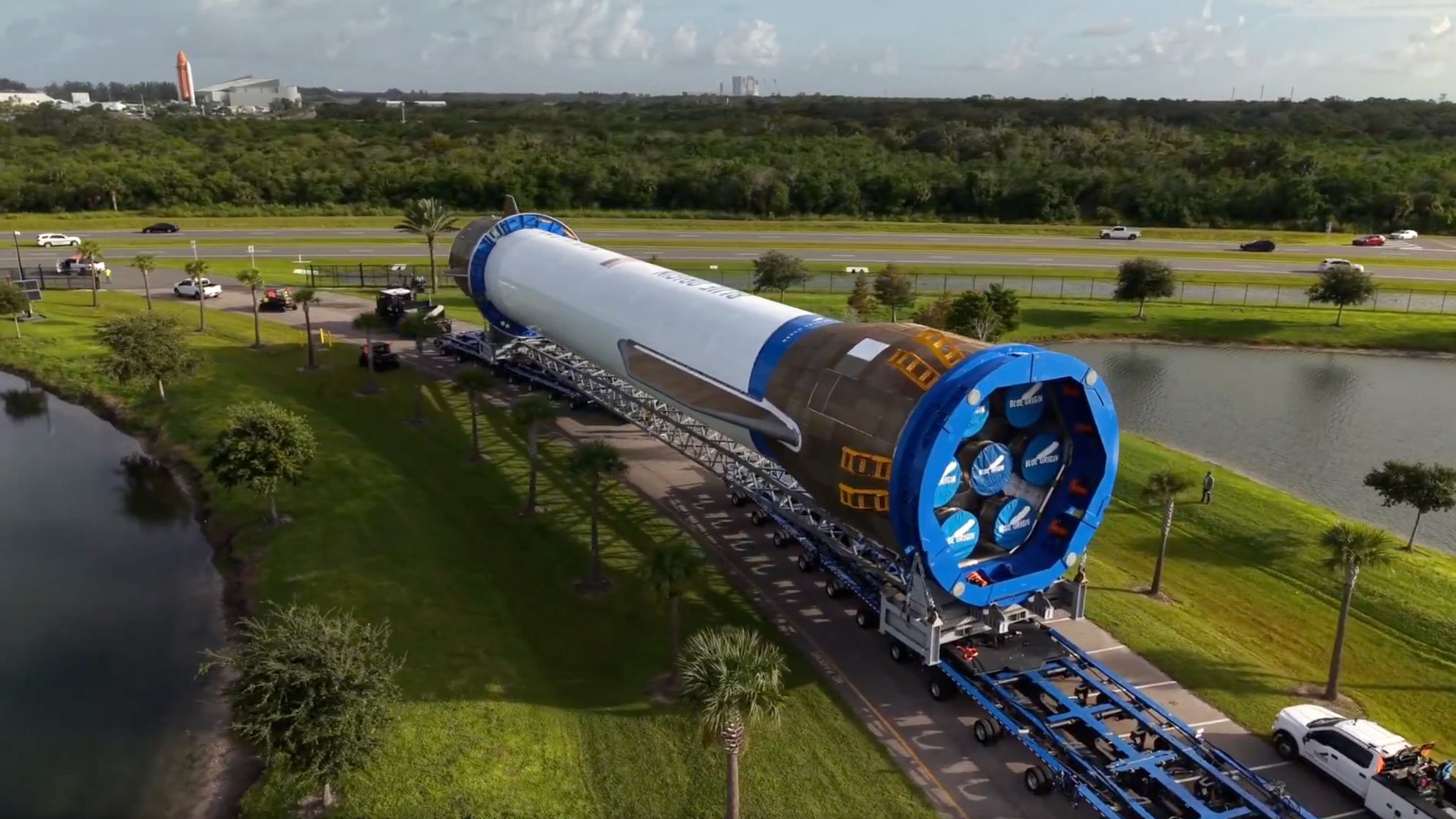
Blue Origin has advanced its heavy-lift capabilities by rolling out the second New Glenn rocket first stage to Cape Canaveral for an operational launch targeting late October or November. This mission will deploy NASA's ESCAPADE probes to Mars, representing a critical milestone for the 320-foot reusable vehicle following its January test flight which achieved orbit but failed first-stage landing. The successful execution of this operational contract is pivotal for Blue Origin's competitive position in the commercial space sector, particularly as it vies for market share against established players like SpaceX.
Blue Origin rolls out powerful New Glenn rocket for testing ahead of Mars launch (video) New Glenn is scheduled to launch NASA's ESCAPADE Mars mission in late October or November. Blue Origin's second New Glenn rocket just made a big move. Jeff Bezos' company rolled a New Glenn first stage out to the launch pad at Cape Canaveral Space Force Station in Florida on Wednesday (Oct. 8) to help prep the vehicle for its upcoming liftoff. That launch, which is expected to take place late this month or in November, will send NASA's twin ESCAPADE probes to Mars. New Glenn stands about 320 feet tall (98 meters) when fully stacked. Like SpaceX's Falcon 9 and Falcon Heavy rockets, the Blue Origin launcher features a reusable first stage. New Glenn debuted this past January on a test flight that reached orbit as planned. Blue Origin tried to land the first stage on a ship at sea after liftoff that day but came up short. Mission number two is an operational flight: It will send the two ESCAPADE ("Escape and Plasma Acceleration and Dynamics Explorers") orbiters rocketing toward the Red Planet, where they will study the Martian atmosphere and how it is affected by the solar wind and space weather. Those two probes — which are named Blue and Gold, and were built by the California-based company Rocket Lab — arrived on Florida's Space Coast on Sept. 22. Breaking space news, the latest updates on rocket launches, skywatching events and more! Wednesday was a big day for Blue Origin. That same morning, the company sent six people to and from suborbital space on its New Shepard vehicle. The mission, which launched from Blue Origin's West Texas site, was the company's 15th human spaceflight and the 36th overall launch of the New Shepard system. Join our Space Forums to keep talking space on the latest missions, night sky and more! And if you have a news tip, correction or comment, let us know at: . Michael Wall is a Senior Space Writer with Space.com and joined the team in 2010. He primarily covers exoplanets, spaceflight and military space, but has been known to dabble in the space art beat. His book about the search for alien life, "Out There," was published on Nov. 13, 2018. Before becoming a science writer, Michael worked as a herpetologist and wildlife biologist. He has a Ph.D. in evolutionary biology from the University of Sydney, Australia, a bachelor's degree from the University of Arizona, and a graduate certificate in science writing from the University of California, Santa Cruz. To find out what his latest project is, you can follow Michael on Twitter. You must confirm your public display name before commenting Please logout and then login again, you will then be prompted to enter your display name. Blue Origin has rolled out its second New Glenn rocket first stage to Cape Canaveral, preparing for an operational launch in late October or November. This mission is slated to deploy NASA's ESCAPADE probes to Mars, representing a critical milestone for the 320-foot reusable vehicle after its January test flight achieved orbit but failed first-stage landing. Successful execution of this operational contract is pivotal for Blue Origin's competitive position in the commercial space sector. The New Glenn's reusable first stage aligns with industry trends, positioning Blue Origin against established players like SpaceX in the heavy-lift market. This mission also highlights Rocket Lab's (RKLB) role, as it manufactured the ESCAPADE probes, indicating potential for increased collaboration within the space industry. The overall sentiment surrounding these developments is moderately positive, reflecting progress in key technological areas.
AI-powered research, real-time alerts, and portfolio analytics for institutional investors.
Request DemoOverall Sentiment
moderately positive
Sentiment Score
0.50
Ticker Sentiment
