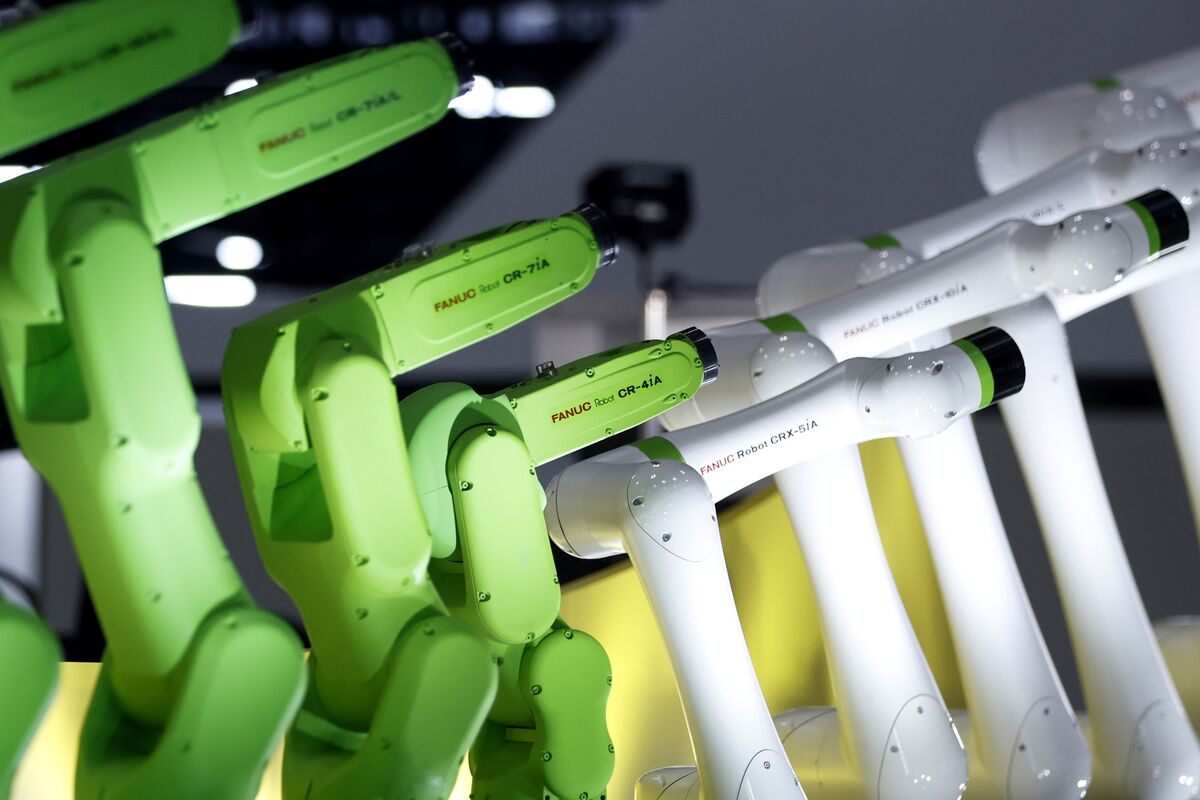
Fanuc said it will partner with Nvidia to integrate Nvidia’s open-source robotic simulation framework into Fanuc’s software and collaborate with Nvidia and software vendors to build robots that better recognize voice commands, avoid injuring people and track moving parts. The announcement sent Fanuc shares up as much as 9.4% to their highest level since July 2021, signaling a positive catalyst that could accelerate adoption of AI-driven factory simulations and automation and bolster Fanuc’s competitive positioning and investor sentiment.
Market structure: The tie-up makes Fanuc (6954.T / FANUY) and Nvidia (NVDA) direct beneficiaries — Fanuc gains software differentiation and go-to-market leverage, Nvidia captures higher-margin GPU demand for industrial customers. Losers include incumbents with weak software stacks (e.g., ABB, KUKA) and small system integrators that can’t match the combined stack; expect 6–18 month market-share pressure on second-tier robot vendors. GPU supply constraints mean rollout is supply-limited initially, lifting GPU spot/forward pricing and NVDA options IV in the near term.
Risk assessment: Tail risks include new US/ALLIED export controls on datacenter GPUs to China (5–15% probability in 12 months) and integration/safety failures that could trigger recalls or liability charges (low single-digit earnings hit). Immediate effect (days) is sentiment-driven; short-term (weeks–months) depends on pilot wins and GPU availability; long-term (2–5 years) could reprice margins if software subscriptions scale. Hidden dependency: adoption hinges on OEM CAPEX cycles and Nvidia’s ability to guarantee supply and support for industrial workloads.
Trade implications: Tactical plays: establish modest equity exposure to Fanuc (2–3% portfolio) and selective NVDA convex exposure via defined-risk options; implement a relative-value pair long FANUY / short ABB to isolate AI-integration alpha. Options: use 6–12 month NVDA call spreads (target ~25–40% OTM, delta ~0.25–0.35) to exploit directional upside while capping IV risk. Rotate 1–3% from legacy industrials into automation/software names over next 4–12 weeks, trimming on 15–25% rallies or post-earnings guidance misses.
Contrarian angles: The market may be overstating near-term revenue — integrating an open-source simulator is incremental; absence of near-term order flow will produce mean reversion (Fanuc’s 9.4% spike is vulnerable). Historical parallels: partnership announcements in industrial tech often deliver a 6–12 month “proof” period before durable order flows; watch for GPU BOM inflation >10% that would compress robot OEM margins and slow purchasing. Monitor concrete KPIs (pilot conversions, disclosed GPU shipments) over the next 60–120 days before adding size.
AI-powered research, real-time alerts, and portfolio analytics for institutional investors.
Request DemoOverall Sentiment
strongly positive
Sentiment Score
0.70
Ticker Sentiment
