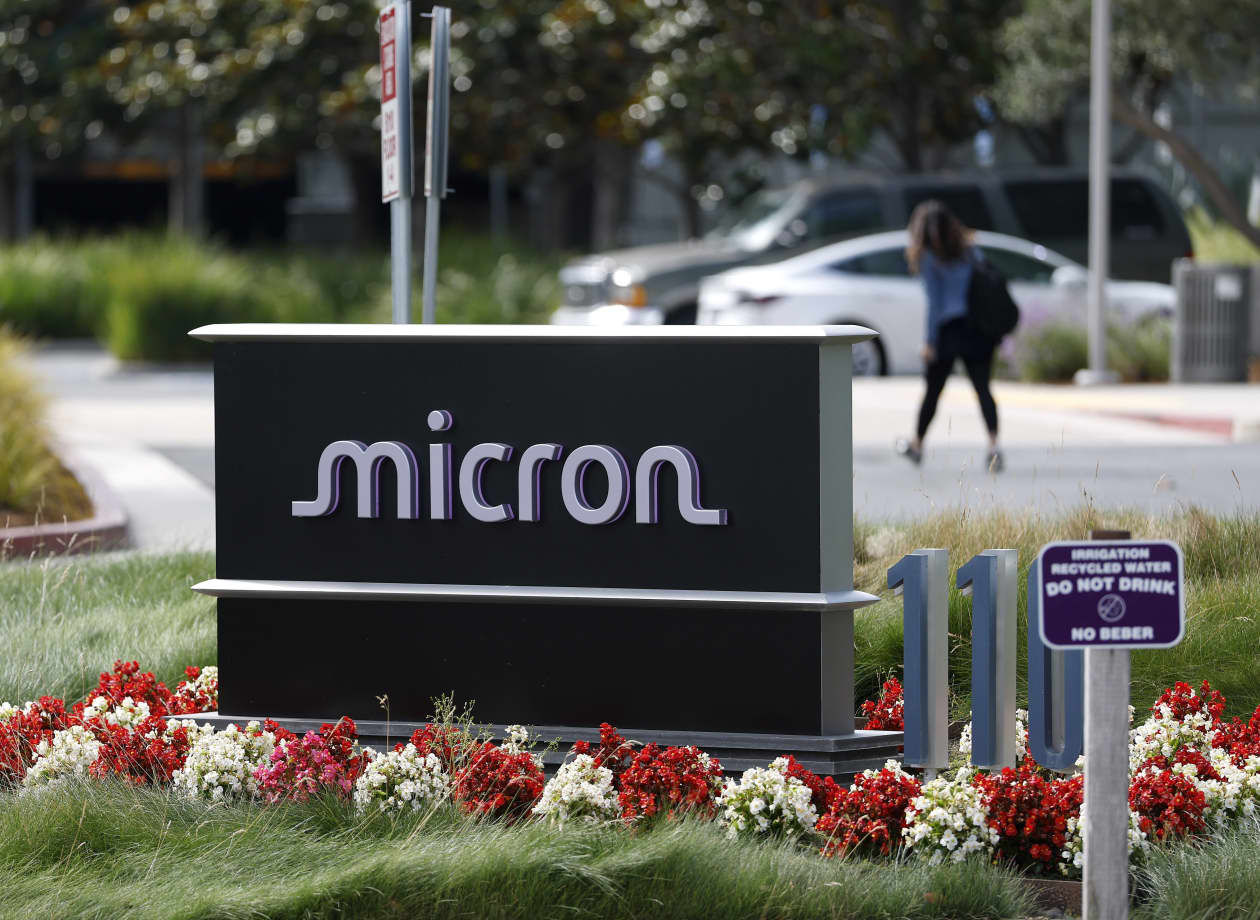
Micron Technology has surged from outside the top 100 U.S. companies at the start of 2025 to a projected No. 13 ranking, with a $665 billion market capitalization. The move reflects rapidly rising investor demand tied to AI infrastructure, where memory chips have become a key bottleneck. The article is primarily a valuation and ranking update rather than a new operational catalyst.
MU’s re-rating is less about a single-product move and more about a regime shift in bargaining power: in AI infrastructure, memory has moved from a commodity input to a strategic constraint. That matters because pricing power in memory can expand faster than volume, and the market typically underestimates how quickly that translates into free-cash-flow inflection once utilization stays tight for multiple quarters. The second-order effect is that capital allocation across the semiconductor complex should increasingly favor vendors with exposed AI memory content over names tied mainly to compute. The main beneficiaries are likely to be the broader memory ecosystem and any downstream AI server integrators that can pass through higher component costs; the losers are hyperscalers and OEMs facing margin compression if memory pricing stays elevated into the next procurement cycle. A subtle but important effect is inventory behavior: once customers believe supply is structurally constrained, they tend to pre-buy, which can extend the pricing cycle by 1-2 quarters and create a self-reinforcing squeeze. That said, this also seeds the eventual reversal if capacity additions outpace demand in late-cycle 2025/2026. The key risk is that the market is now pricing MU as if scarcity is durable, when memory historically mean-reverts hard once capex ramps and lead times normalize. If AI capex growth decelerates, or if a competitor meaningfully expands supply, the stock can de-rate faster than earnings can fall because the multiple is now embedding an exceptional cycle. Near-term catalysts are upcoming pricing commentary, gross margin guidance, and any signal that customers are pulling in orders ahead of potential shortages. The contrarian view is that the move may be partially overdone in market-cap terms even if fundamentals remain strong, because investors may be extrapolating a structural scarcity premium from a cyclical bottleneck. The best risk/reward may not be outright long MU after a large run, but owning it versus lower-quality semiconductor exposure where AI enthusiasm has not translated into pricing power. If memory pricing stays tight for another 2-3 quarters, the earnings revisions could still surprise to the upside; if not, the de-rating could be swift.
AI-powered research, real-time alerts, and portfolio analytics for institutional investors.
Request DemoOverall Sentiment
moderately positive
Sentiment Score
0.55
Ticker Sentiment
