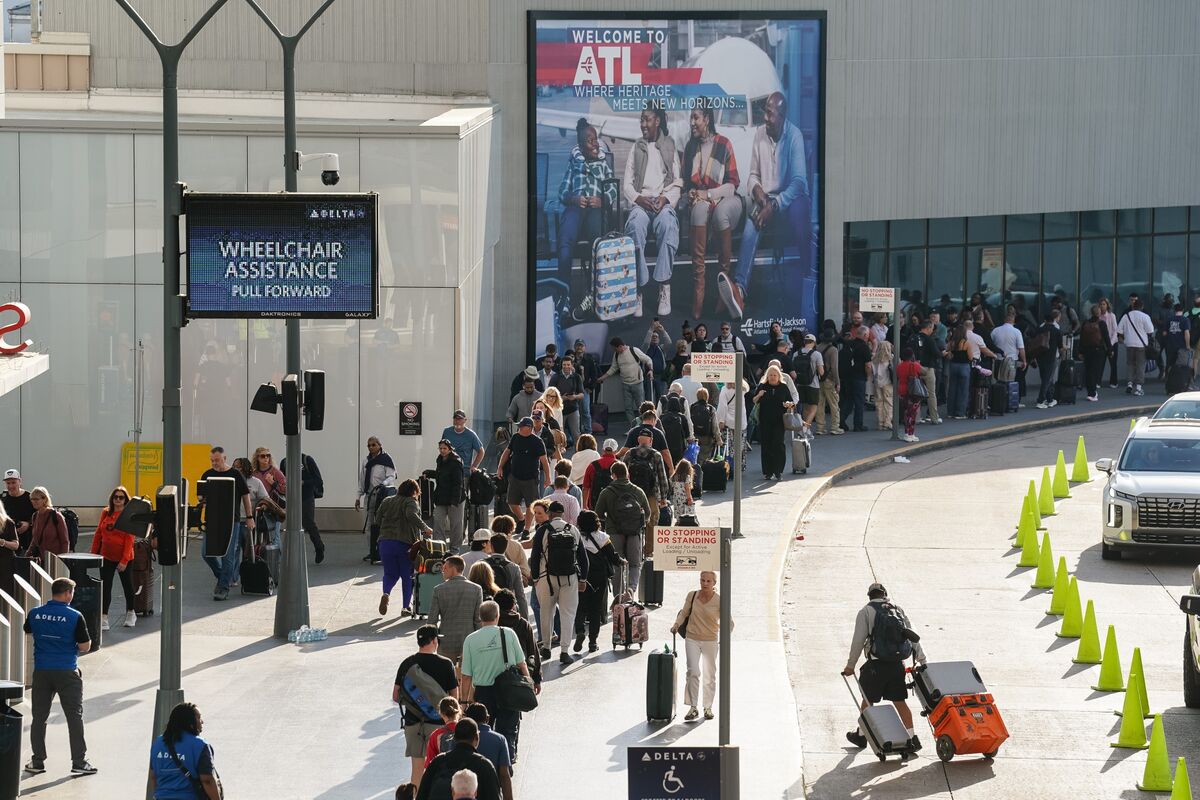
DHS shutdown continues after Senate Democrats rejected a Trump-backed Republican plan to fund most of the Department of Homeland Security, prolonging operational gaps and snarling airport security checkpoints. The Republican offer excluded Democratic ICE reform demands, increasing political uncertainty and risk of travel disruptions and broader economic spillovers in an economy already strained by the Iran war.
Airline and airport P&Ls are the most immediate transmission mechanism: throughput shocks compress unit revenue and force incremental operational spend (overtime, rebooking, handling). As a rule of thumb, every 100k fewer enplanements per day implies roughly $30–40m of lost gross ticket revenue and elevated re-accommodation costs that hit margins before any fare recovery; this becomes material for carriers with thin liquidity within a 4–8 week window. Contractor dynamics are asymmetric across the DHS value chain: near-term appropriations friction delays services/consulting receipts (1–2 quarters), while capital equipment vendors that produce screening hardware and automation stand to win lumpy, catch-up funding cycles 6–12 months out. Expect a two-speed recovery: services bookings slide first, then capex accelerates if policymakers opt for a politically palatable “technology fix” rather than headcount changes. The supply-chain secondaries are non-linear — modest airfreight delays (3–5 days) during peak inventory windows can lift spot air rates 20–50%, cascading into higher retail softness and inventory write-down risk in the following quarter. Key catalysts to watch are holiday travel schedules (days–weeks), Senate procedural votes (days), and any reconciliatory appropriations language that explicitly earmarks screening tech (6–12 months); a court or political event that reallocates attention to border security could flip budget flows quickly.
AI-powered research, real-time alerts, and portfolio analytics for institutional investors.
Overall Sentiment
mildly negative
Sentiment Score
-0.35
