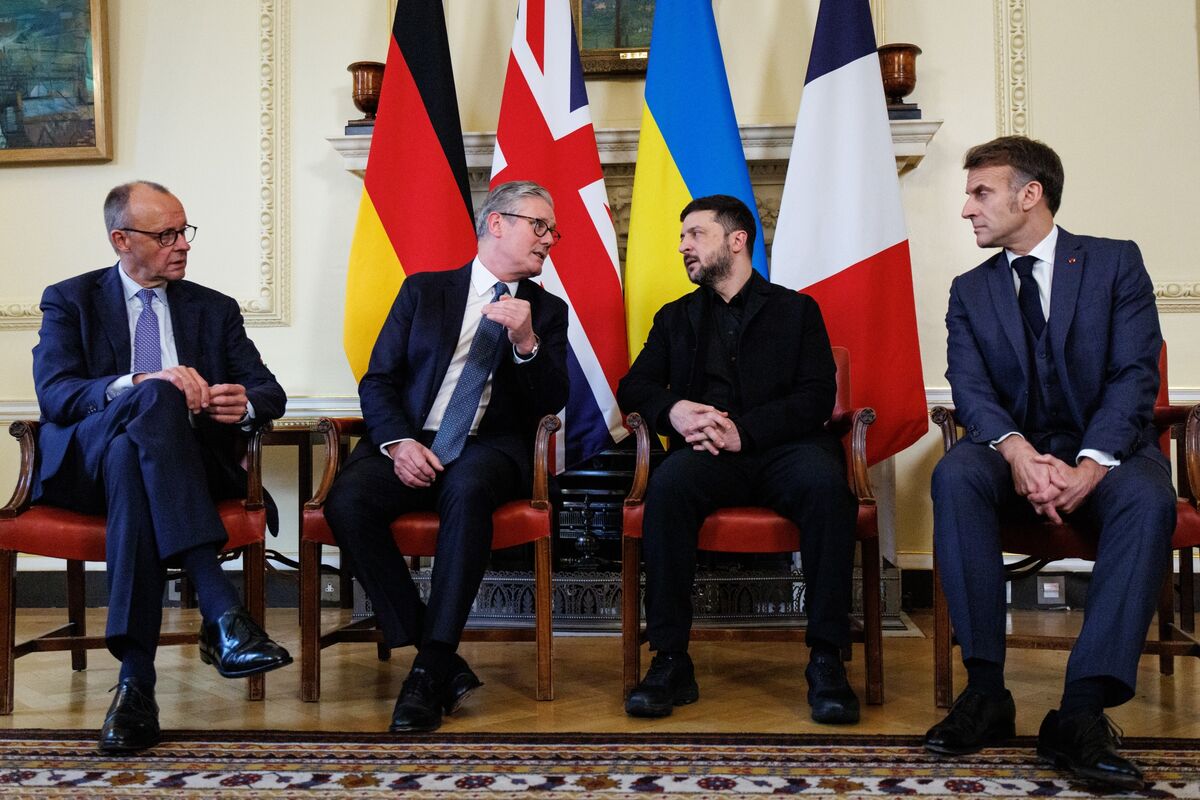
UK opposition leader Keir Starmer is hosting Ukrainian President Volodymyr Zelenskiy and coordinating with German Chancellor Friedrich Merz and French President Emmanuel Macron to boost European influence in Ukraine peace talks that have been dominated by Moscow–Washington discussions. Zelenskiy told Bloomberg negotiators remain divided over the future of the Donbas after an initial 28-point plan reportedly proposed Ukraine cede territory, a ban on NATO membership and limits on its military — developments that raise geopolitical uncertainty and could affect regional stability and investor risk assessments.
Market structure: Geopolitical bargaining centered in Europe shifts marginal pricing power to defense, energy and FX hedges. If negotiations falter, expect a 5–20% surge in defense contractors' visible backlog (LMT, RTX, GD) and renewed upside in European natural gas and oil; if a compromise emerges, those sectors could retrace 10–25% within 3–6 months. European political influence rising (UK/FR/DE coordination) reduces pure US-Russia bilateral risk but increases policy complexity and idiosyncratic EU political risk.
Risk assessment: Tail risks include a major Russian escalation (nuclear posture or full energy cutoff) with low probability but >10% portfolio loss potential in equities and 20–40% jump in gas prices over 6–12 months. Near term (days–weeks) expect volatility spikes in FX and energy; short term (1–6 months) pricing will be driven by announced concessions; long term (1–3 years) outcomes hinge on military budgets and NATO future access. Hidden dependencies include winter gas inventories, EU political calendar, and US domestic politics as a negotiation backstop.
Trade implications: Tactical plays: favor short-dated option exposure to defense names and outright long exposure to gas and USD as asymmetric hedges. Cross-asset: buy U.S. duration (TLT) on risk-off, buy EUR puts if European unity weakens, and use call spreads on ITA/LMT for directional defense exposure with defined risk over 3–6 months.
Contrarian angles: Consensus assumes perpetual defense upside; markets underprice a diplomatic ceasefire risk that would compress defense and energy premiums by ~10–25% in 3 months. A balanced book uses small long defense exposure funded by liquid short-dated puts or small collars to capture volatility without being overexposed to a negotiated de-escalation.
AI-powered research, real-time alerts, and portfolio analytics for institutional investors.
Request DemoOverall Sentiment
mildly negative
Sentiment Score
-0.25
