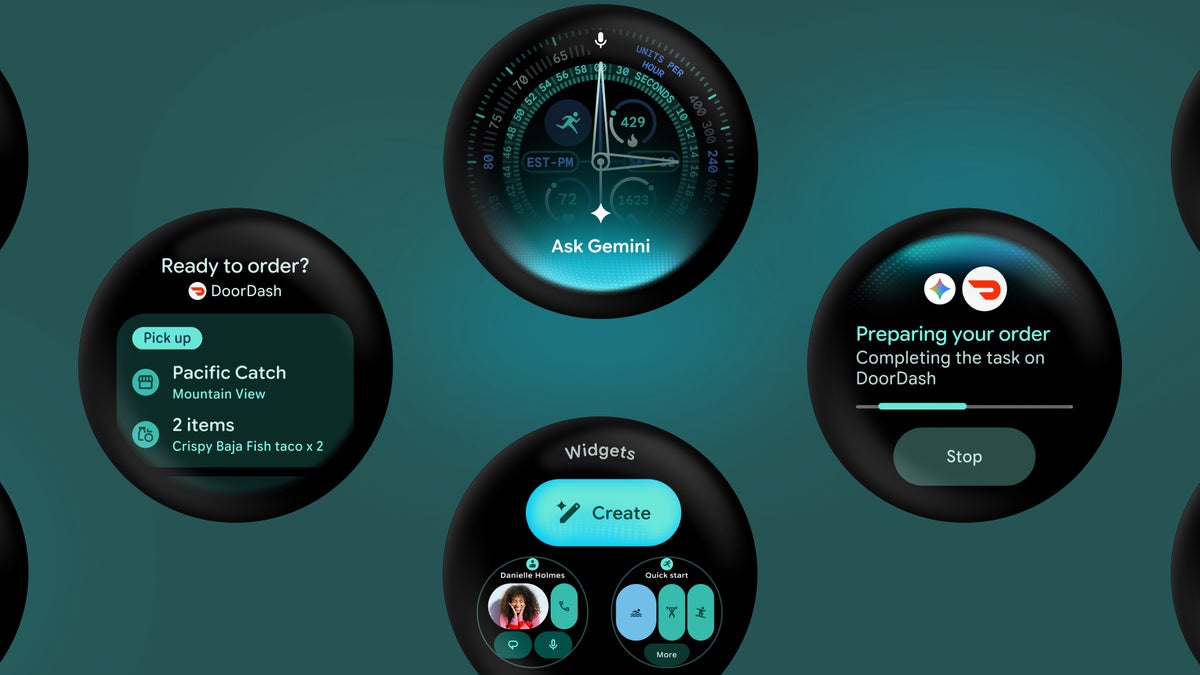
Google unveiled Wear OS 7 at I/O 2026, adding Gemini-powered actions, Live Updates, Wear Widgets, smarter media controls, and a new workout tracker. Google says watches upgrading from Wear OS 6 can expect about 10% better battery life, while the platform will ship on watches later in 2026. The update is a meaningful product refresh for Pixel Watch and partner devices, but near-term market impact is likely limited.
GOOGL is the primary beneficiary because this is less a watch software refresh than a distribution wedge for Gemini into a high-frequency, low-friction surface. The second-order effect is that wearables become a more credible control layer for commerce, media, and health workflows, which increases the odds that Google captures more query-to-action events before they ever reach the phone. That matters because it extends Google’s AI monetization pathway beyond search screens and into ambient intent, where competitors with weaker ecosystem integration will struggle to match engagement quality.
The biggest near-term loser is not Apple outright, but any wearable or fitness app that relied on differentiated lightweight UX to justify its own interface layer. If Google standardizes app actions, widgets, and live updates, third-party developers get commoditized at the UI level while Google owns the orchestration layer. For DASH, the implication is modest but real: wrist-initiated ordering reduces friction in impulse-driven use cases, but the uplift is likely incremental rather than category-changing unless Google proves the automation loop meaningfully increases conversion and frequency.
Timeline matters: the stock-level impact should be more about 6-18 month platform sentiment than immediate revenue revisions. The key catalyst is developer adoption across the next two device cycles; if top fitness, media, and commerce apps integrate quickly, Google can argue for a stickier AI ecosystem and higher retention on Android hardware. The main risk is execution asymmetry: if rollout is limited to a narrow device set, or if battery/latency gains disappoint in real-world use, the narrative flips from platform expansion to another fragmented Android feature launch.
The contrarian view is that the market may overestimate consumer willingness to use a wrist as an AI control plane. Most users tolerate a smartwatch for passive notifications, not proactive task completion, and automation errors are punished more harshly on a wrist than on a phone. So the bullish case on GOOGL is real but probably under-earning in the short run; the more durable upside is ecosystem lock-in and data collection, not immediate hardware monetization.
AI-powered research, real-time alerts, and portfolio analytics for institutional investors.
Request DemoOverall Sentiment
mildly positive
Sentiment Score
0.35
Ticker Sentiment
