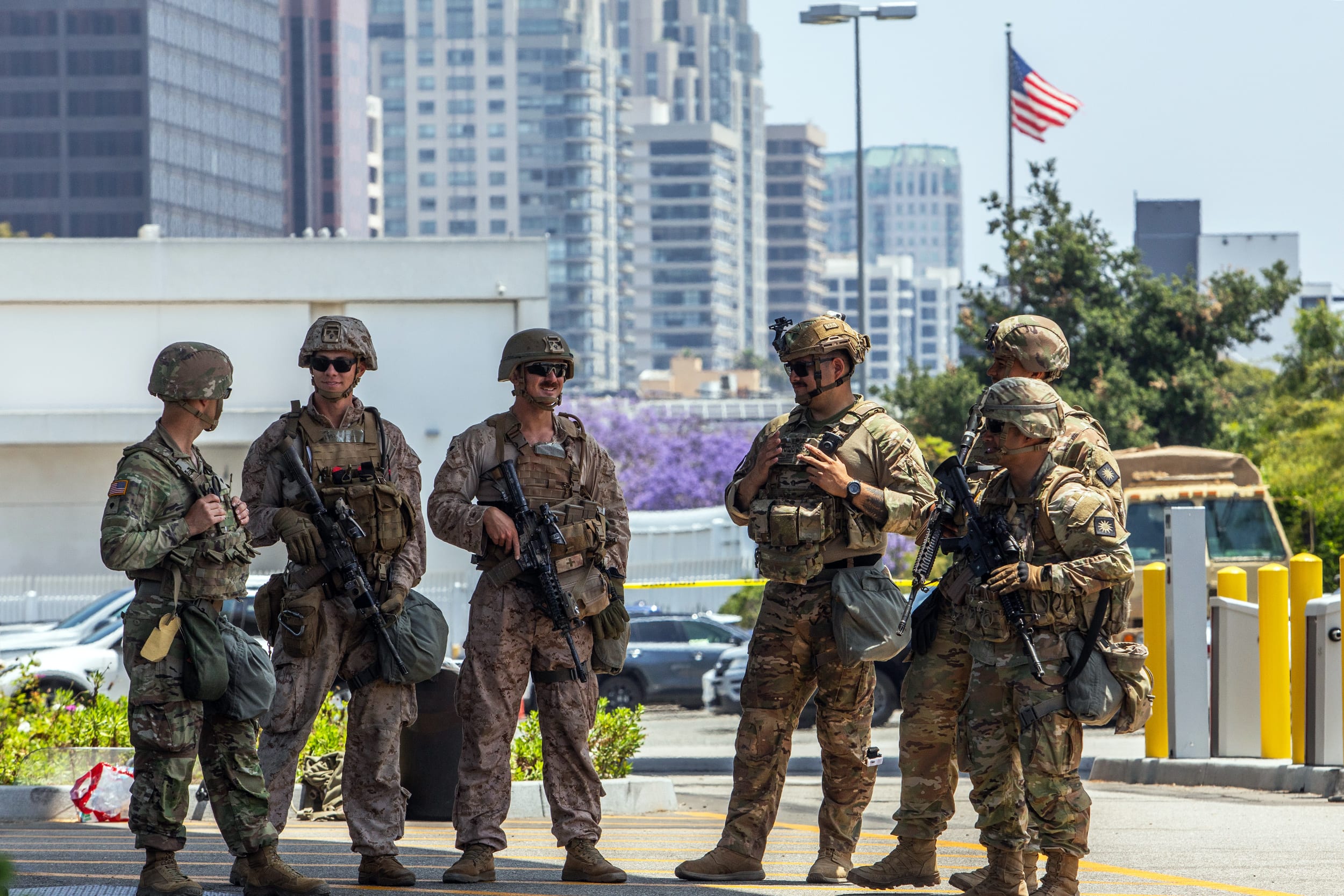
The administration withdrew National Guard troops from Chicago, Los Angeles and Portland between Jan. 6 and Jan. 21, while roughly 2,500 Guard members remain in Washington, D.C. and are expected to stay through year-end; troops in Memphis and New Orleans remain federally funded but under state control. The deployments provoked criticism from state and civil-rights leaders and suffered judicial setbacks, including the Supreme Court's December refusal to block a lower court order preventing Chicago mobilization, a development that raises domestic political and legal risk but has limited direct market consequences.
Market structure: The pullback of federally deployed National Guard forces is a net neutral-to-mild negative for private security contractors and tactical equipment vendors that saw short-term uplifts from deployments, and a modest positive for states/cities that regain budget autonomy. Defense primes (LMT, NOC, GD, RTX) are largely insulated because National Guard missions are small relative to DoD procurement, but contract mix could shift toward domestic ISR/logistics vendors (LDOS, PLTR) in pockets like D.C.; expect 0–2% reallocation between federal domestic-security spend and traditional defense over 3–12 months.
Risk assessment: Tail risks include election-period escalation (low-probability, high-impact) driving muni-credit stress in urban issuers (Chicago/LA/Portland) and widening city-specific muni spreads by 30–100bps within days–weeks, triggering a risk-off move that rallies Treasuries (TLT +1–3% intraday). Hidden dependency: federally funded but state-controlled troop presence (Memphis/New Orleans) means disputed legal rulings, not troop counts, will drive market moves; key catalysts are court rulings and DOJ memos over next 30–90 days.
Trade implications: Tactical: overweight large-cap defense equities (LMT/NOC) via outright 1–2% portfolio positions for 3–12 months, but use 3–6 month call spreads to cap upside vs policy risk. Hedging: allocate 1% to long TLT or buy 3-month ATM puts on S&P (SPY) if city unrest metrics (FBI/city crime indices or 7-day protest counts) rise >25% month-over-month; sell or underweight municipal bonds concentrated in Chicago/LA if city-specific spreads widen >40bps vs national munis.
Contrarian angles: Consensus downplays legal constraints — a Supreme Court or federal-court precedent limiting domestic mobilizations would remove a short-lived revenue tail for private contractors, pressuring equities that priced in sustained deployments. Conversely, markets may underprice a persistent D.C. Guard presence through year-end; small-cap homeland-security and federal IT vendors (LDOS, PLTR) could out-perform by 5–10% if federal domestic budgets reallocate toward surveillance/IT over 6–12 months.
AI-powered research, real-time alerts, and portfolio analytics for institutional investors.
Request DemoOverall Sentiment
neutral
Sentiment Score
0.00
