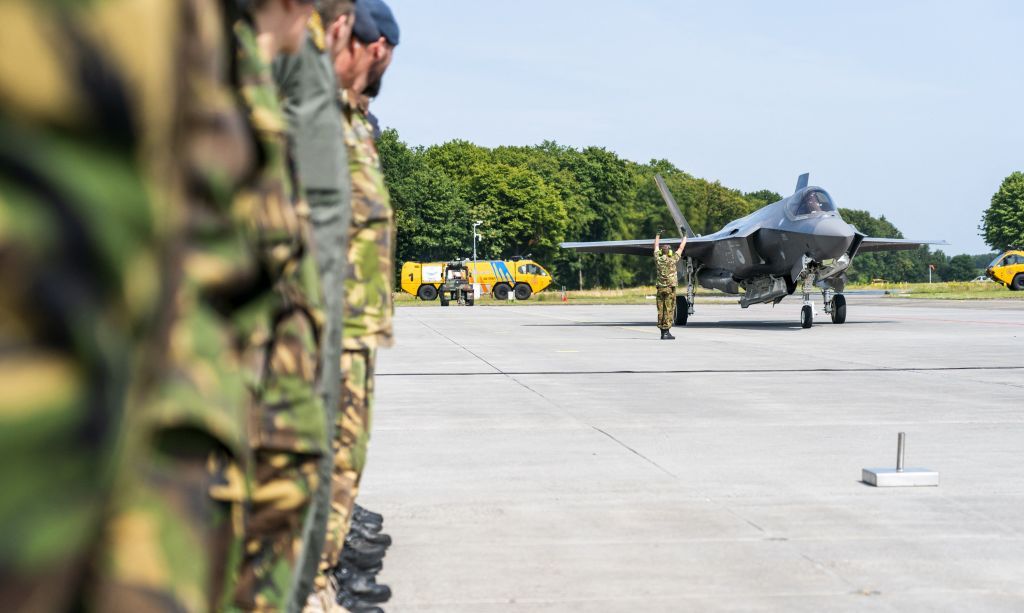
Dutch forces opened fire on unidentified drones detected over Volkel Air Base — a site that houses U.S. nuclear weapons and Dutch F-35s — but the drones left the area and have not been recovered; the incident is under investigation. The sighting is part of a broader pattern of unexplained drone incursions across multiple European countries this autumn that Western officials suspect, but cannot prove, may be linked to Russia, raising near-term regional security risks and potential tactical upside for defense contractors while keeping investor sentiment cautious.
Market structure pivots toward defense primes (RTX, LMT, LHX) and specialist counter‑UAS/cyber vendors (KTOS, AVAV, PANW) as short‑term procurement and retrofit demand rises; commercial aviation, travel operators and regional European suppliers are the direct losers as risk‑off reduces utilization and discretionary air traffic forecasts by ~3–7% near‑term. Pricing power shifts: defense contractors can push for 3–8% price uplifts on urgent retrofit contracts while small suppliers face order‑book bottlenecks because avionics and RF components have 6–18 month lead times, tightening supply versus spike in demand.
Tail risks include a low‑probability kinetic escalation or state‑attribution leading to sanctions that could re‑route supply chains and freeze cross‑border contracts (impacting non‑US primes); immediate market moves (days) will be liquidity driven, short‑term (weeks–months) will reflect procurement signals, and long‑term (quarters–years) depends on sustained NATO/EU budget increases (>+5% p.a.). Hidden dependencies: US Congress appropriations, export controls on semiconductors, and satellite imagery vendors that validate origin all materially change outcomes.
Trade implications: favor front‑line defense and counter‑UAS exposure now but size positions conservatively given political execution risk; expect equities' implied volatility +25–40% relative to pre‑event levels, creating attractive call‑spread opportunities while avoiding outright long gamma. Cross‑asset: Treasuries likely bid as a safe haven (2s down 10–25bps in shock), USD strength versus EUR (EURUSD downside 2–4%), oil up modestly if escalation risks perceived (WTI +2–5%).
Contrarian view: consensus may overpay large primes on headline risk — smaller, under‑owned systems integrators (KTOS, AVAV) can outperform if orders are modular and fast‑track (3–9 months); conversely, if origin is never attributed or deemed non‑state, tradeable defense premium will fade within 3 months. Historical parallel: post‑Crimea 2014 saw a 12‑month re‑rating in select defense names, but dispersion was high — favor selective names with visible backlog and export clearances.
AI-powered research, real-time alerts, and portfolio analytics for institutional investors.
Request DemoOverall Sentiment
moderately negative
Sentiment Score
-0.40
