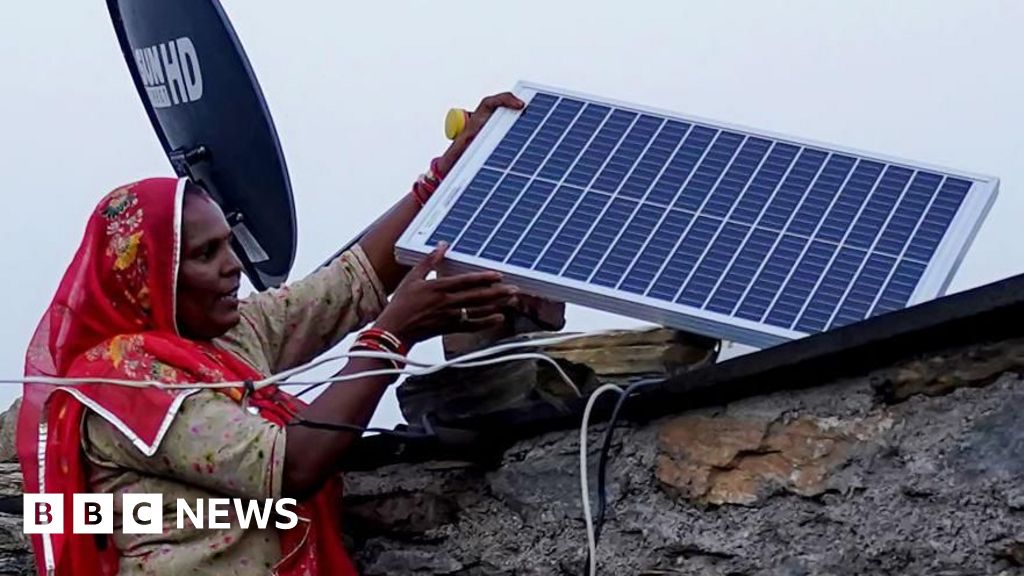
India, now the world’s third-largest solar producer with solar supplying over 20% of capacity and roughly 2.4 million subsidised rooftop households, faces a growing end-of-life panel waste problem that could reach an estimated 11 million tonnes by 2047. A CEEW study estimates managing that volume will require about 300 dedicated recycling facilities and roughly $478m of investment over two decades; current enforcement of 2022 e‑waste rules is uneven and most facilities today recover only low-value materials. The situation presents both a regulatory/risk challenge for the renewables rollout and a potential investment opportunity in recycling infrastructure and materials recovery (reclaiming an estimated 38% of panel materials and avoiding 37m tonnes of mining-related CO2).
Market structure: The looming 11 million-tonne Indian solar-waste wave to 2047 (CEEW) and the near-term 100k–600k t projection to 2030 create a capital-light service opportunity: ~300 recycling facilities and $478m capex over 20 years implies attractive ROIC for early entrants. Winners are specialist recyclers, sorting/automation suppliers and large utilities that internalize take-back (e.g., TATAPOWER.NS, ADANIGREEN.NS) which gain pricing power from scarce collection networks; pure-play panel manufacturers (FSLR, TAN) face margin pressure from EPR compliance and higher LCOE if costs are passed on. Downstream commodity markets (glass/aluminium) see stable secondary supply, while silver/copper dynamics will tighten near-term but face long-term downward pressure as reclaimed metals scale.
Risk assessment: Tail risks include rapid regulatory tightening (national mandates + fines), large-scale illegal dumping, or a technology shift (longer-lasting panels) that compresses waste volumes; each could move returns by >50% vs base case. Time horizons: immediate (0–12 months) is policy noise and tender announcements; short (12–36 months) is capacity build-out and contract wins; long (>3 years) is material waste flow and reclaimed-metal supply. Hidden dependencies: rooftop tracking/collection economics and informal-sector behavior; second-order risk is recycled-metal price leakage into global commodities.
Trade implications: Establish 2–3% longs in specialist recyclers: Umicore (UMI.BR) and Tomra (TOM.OL) with 12–24 month horizon to capture contract tendering and automation adoption; fund sizing assumes ~10–15% IRR if they win municipal/utility contracts. Pair trade: long UMI.BR + TOM.OL vs short TAN (solar ETF) 1:1 notional over 6–12 months to reflect regulatory cost transfer; implement via buy-call spreads on recyclers and buy put spreads on TAN to cap risk. Add tactical 1–2% long SLV to hedge silver tightness if recycling rollout lags.
Contrarian angles: Consensus underestimates recurring revenue from recycling services and EPR enforcement: $478m capex over 20 years is small relative to global asset managers and suggests consolidation opportunities and M&A. Reaction may be underdone for recyclers and overdone for solar manufacturers priced for uninterrupted cost declines; historical parallel: wind turbine decommissioning created a service oligopoly and attractive returns for recyclers. Watch for a policy trigger: India announcing >$100m recycling subsidy or binding EPR deposit >5% of panel price — that should materially re-rate recycling equities upwards.
AI-powered research, real-time alerts, and portfolio analytics for institutional investors.
Request DemoOverall Sentiment
mildly negative
Sentiment Score
-0.25
