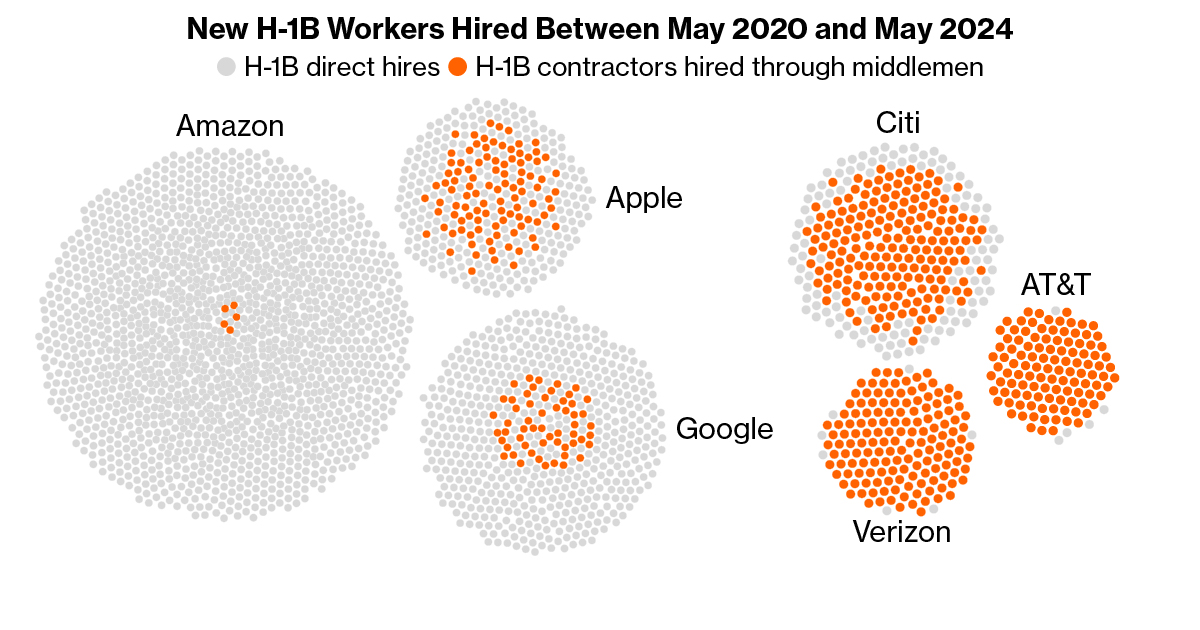
New data reveals that major non-tech companies, including Citigroup and Capital One, are significant H-1B visa users, often indirectly hiring lower-paid IT contractors through staffing and outsourcing firms. These "visa middlemen" secure roughly half of annual H-1Bs, sometimes through lottery manipulation, resulting in contractors being paid substantially less—e.g., $48,000 less for software developers—than direct hires for comparable roles. This growing reliance on outsourced H-1B labor, which experts suggest is only a fraction of broader service job offshoring, raises concerns for institutional investors regarding potential wage suppression, worker exploitation, and future regulatory scrutiny for firms employing this model.
New data reveals a significant, and previously opaque, reliance on H-1B visa contractors by major non-tech corporations, including Citigroup, Capital One, Verizon, and AT&T. These firms utilize third-party staffing and outsourcing agencies, or "visa middlemen," who secure approximately half of the 85,000 annual H-1B visas, often through questionable means such as lottery manipulation via "multiple registration." This practice facilitates significant cost savings for end-client companies, as contractors are paid substantially less than direct hires in comparable roles; for instance, H-1B software developers hired through contractors earned approximately $48,000 less than their directly employed counterparts. This model exposes these corporations to considerable risk. Capital One, in particular, demonstrates high exposure, with over half of its 905 H-1B contract workers sourced from firms that engaged in multiple registrations. The practice also carries legal and regulatory liabilities, highlighted by a US Equal Employment Opportunity Commission investigation into a key supplier, Tata Consultancy Services, and the potential for future legislative crackdowns, such as the reinstatement of a rescinded Department of Labor rule holding end-clients accountable for pay equity. While the identified contractors represent a small portion of these companies' total workforces, experts suggest this data is merely the "tip of the iceberg" of a broader, poorly tracked trend of service job offshoring, signaling a potential systemic vulnerability and governance issue for the firms involved.
AI-powered research, real-time alerts, and portfolio analytics for institutional investors.
Overall Sentiment
strongly negative
Sentiment Score
-0.65
Ticker Sentiment
