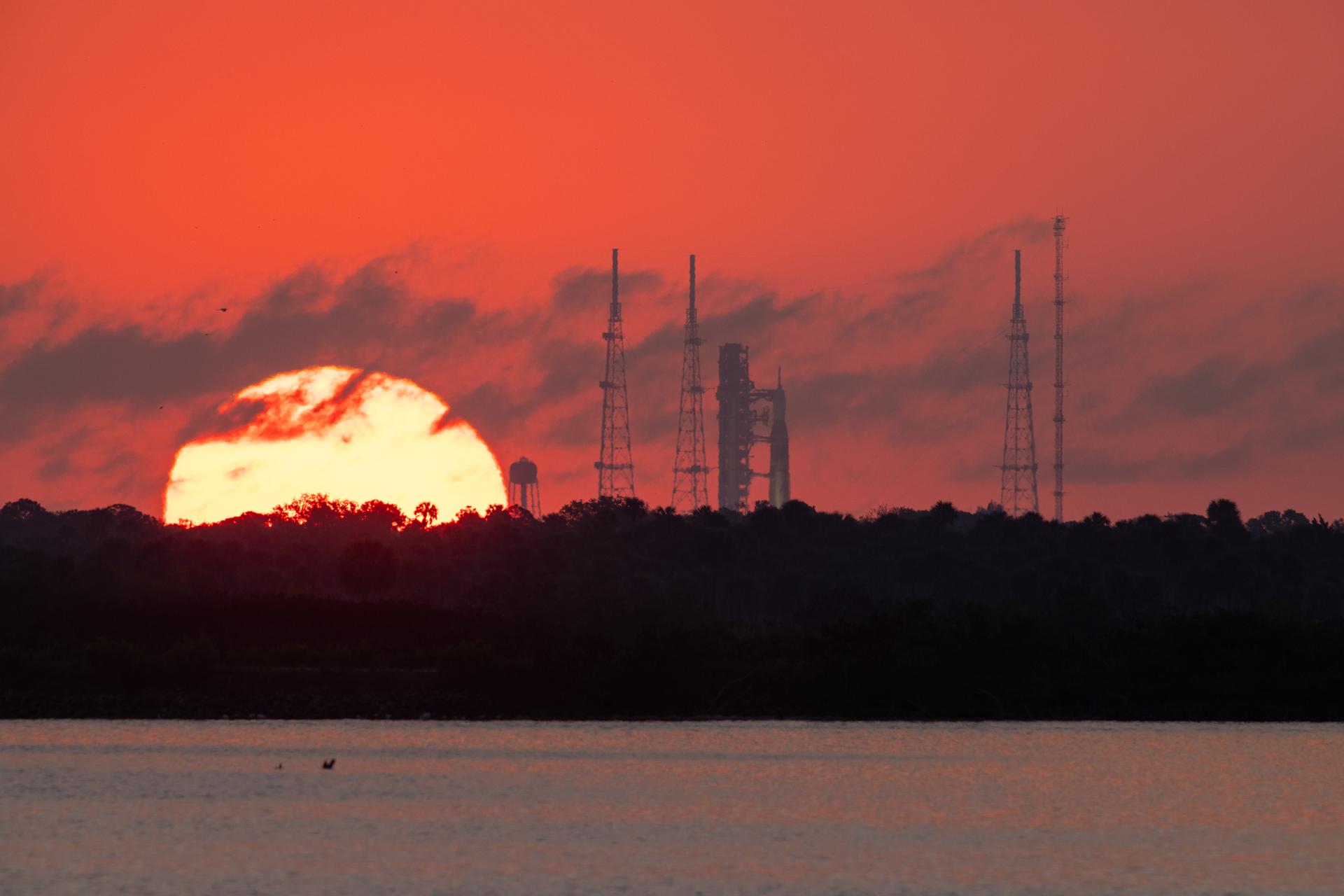
NASA is preparing the SLS rocket and Orion spacecraft for the crewed Artemis II launch as early as Wednesday, April 1, with pad operations and final engineering tests underway. The four-person crew (Reid Wiseman, Victor Glover, Christina Koch, Jeremy Hansen) began quarantine on March 18 and will fly to Florida on March 27; the mission is planned to last approximately 10 days. Ground teams have completed pad hookups, crew access arm installation, and will perform ordnance and RF connectivity checks before countdown.
The immediate winners are prime defense/aerospace suppliers that deliver flight hardware, ground systems and mission avionics — their near-term revenue becomes less lumpy and more contractible as NASA de-risks human lunar operations. Second-order beneficiaries include RF/telemetry vendors and test-equipment suppliers (high-margin, recurring-services pockets) which see a step-up in demand for pad-specific RF certification and integrated end-to-end testing; that can convert one-off build work into multi-year service contracts worth low hundreds of millions across the supplier base within 12–36 months.
Tail risks cluster around technical and schedule failure modes that disproportionately hurt the largest exposed integrators: a pad ordnance, FTS, or RF anomaly that forces a multi-month stand-down will push cost-to-complete into the next fiscal year and likely trigger contract change orders and penalty provisions. Operational delays compress revenue recognition and create visible quarterly EPS volatility — a single multi-month slip can swing 2026 EPS for a prime by ±8–15% depending on backlog mix and accounting treatment.
From a capital-markets angle, the event is a binary catalyst: a clean crewed flight removes a major program execution overhang and can re-rate suppliers via multiple expansion (10–25% potential upside in 6–12 months for mid-cap subsystem providers). Conversely, a high-profile failure would amplify political scrutiny, increase insurance and warranty reserves across the supply chain, and likely push programmatic work toward larger, vertically integrated primes with balance-sheet heft — widening the gap between winners and execution-challenged players.
Consensus risk: the market tends to treat this as an engineering milestone rather than an earnings catalyst. That underweights the durable services follow-on (sustainment, testing, telemetry) that justify holding selective suppliers through a potential 1–2 quarter volatility window and could produce >20% compounding upside if the mission validates repeatable human lunar ops.
AI-powered research, real-time alerts, and portfolio analytics for institutional investors.
Request DemoOverall Sentiment
neutral
Sentiment Score
0.00
