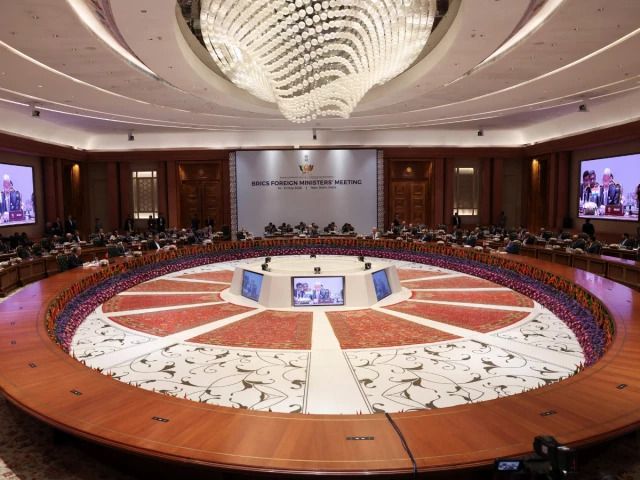
BRICS foreign ministers met in New Delhi amid escalating Iran-related conflict, with India warning of "considerable flux" and rising economic uncertainty. Disruptions around the Strait of Hormuz and Gulf shipping routes are keeping oil and gas markets volatile, pressuring energy-importing economies such as India, which sources roughly half its crude via Hormuz. The article also highlights India's increased reliance on Russian crude as a backstop, underscoring broader supply-chain and energy-security risks.
The market is likely underpricing the asymmetry between headline risk and realized supply disruption. Even without a full Hormuz closure, persistent harassment of shipping raises freight, insurance, and inventory-financing costs in a way that can lift delivered crude prices faster than benchmark Brent, which matters most for refiners and import-dependent Asian economies. The second-order winner is not just upstream energy, but the entire non-U.S. logistics stack that can re-route barrels and capture scarcity premia: tanker owners, alternative crude suppliers, and traders with optionality on blending and arbitrage. India’s pivot to alternative supply sources is a medium-term relative-value signal rather than a one-off procurement story. Russian crude, and to a lesser extent discounted barrels from sanctioned or geopolitically flexible suppliers, likely retain strategic relevance so long as Middle East transit risk stays elevated; that supports widening differentials for compliant Middle East grades versus non-OPEC alternatives. The losers are Asian refiners with tighter feedstock flexibility and industrials exposed to higher working capital needs, especially if energy volatility filters into fertilizers, food, and transport. The key catalyst path is not war expansion alone, but any evidence of sustained disruption to shipping insurance, port turnarounds, or a rise in forward curve backwardation over the next 2-8 weeks. Conversely, a ceasefire headline or coordinated naval protection could quickly collapse the risk premium, but only if physical flows and insurer behavior normalize. The bigger contrarian point: the market may be too focused on spot oil and not enough on the volatility regime shift, which tends to benefit option sellers only after realized vol peaks, not on the first move. For positioning, the cleaner expression is long energy volatility and logistics optionality rather than outright beta to crude. If the situation de-escalates, these trades bleed less than direct oil longs; if it escalates, they still capture the repricing of transport scarcity and geopolitical risk premia.
AI-powered research, real-time alerts, and portfolio analytics for institutional investors.
Request DemoOverall Sentiment
moderately negative
Sentiment Score
-0.35
