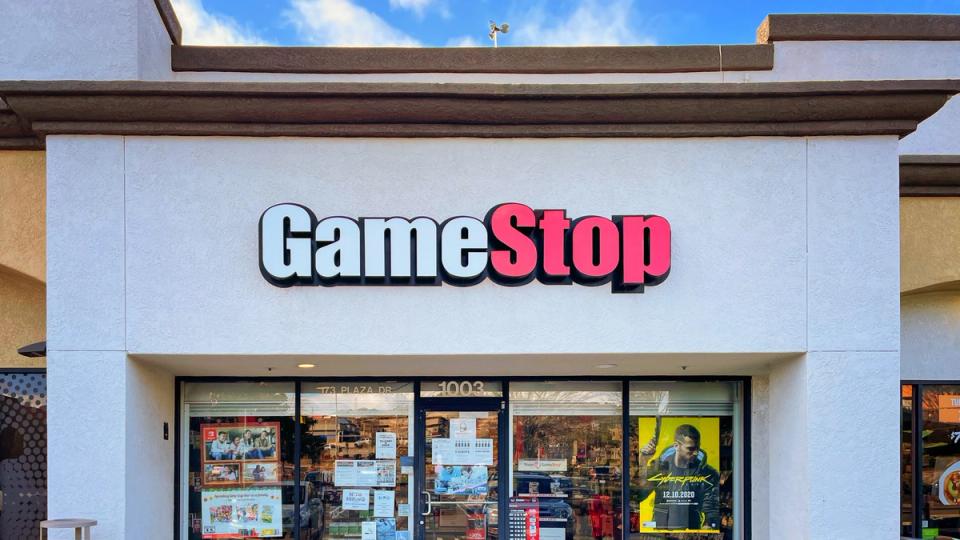
GameStop has proposed a $55.5 billion acquisition of eBay, offering $125 per share in cash and stock, a 46% premium to eBay's early-February price. The company says it could fund the deal with $9.4 billion of cash and liquid investments plus up to $20 billion in financing, but the size of the bid raises questions about whether it will sell its roughly $368 million bitcoin stake. The transaction would materially expand GameStop into e-commerce and could be a major catalyst for GME and EBAY shares.
The market is likely mispricing the financing stack as neutral; the key issue is not whether GME can fund the bid, but whether it can do so without destroying the signaling value of its bitcoin treasury. Once a crypto treasury becomes a financing source, it stops functioning as a reserve asset and starts trading like a quasi-liquid sleeve, which raises the odds of a future sell-the-rally dynamic in GME if execution slips or debt terms come in punitive. The biggest second-order effect is governance: management has effectively told holders that capital allocation will be judged against “expansion optionality,” not balance-sheet purity, so the BTC position becomes a bolt-on source of liquidity rather than a strategic reserve. For EBAY, the bid creates a short-duration valuation floor but also an overhang: even if the deal never clears, the strategic value narrative can compress the downside because there is now a visible bidder with both cash and leverage capacity. However, the real catalyst is not the headline offer; it is whether financing markets price GME as a credible acquirer. If lenders balk or the equity market rejects dilution, the transaction becomes a financing stress test, and GME likely de-risks by monetizing non-core assets, including crypto, before touching the core operating business. The contrarian view is that selling BTC may actually be the least bad outcome for GME shareholders if the company is serious about a pivot into commerce: a clean liquidation of a small, volatile asset avoids a slower bleed from holding it as a mark-to-market distraction. The better trade is not to own the story outright, but to express the divergence between headline optionality and execution reality. The most interesting setup is that GME’s volatility can stay elevated even if the bid fails, because the market must still handicap follow-on M&A, further dilution, or asset sales over the next 1-3 months.
AI-powered research, real-time alerts, and portfolio analytics for institutional investors.
Overall Sentiment
mildly positive
Sentiment Score
0.15
Ticker Sentiment
