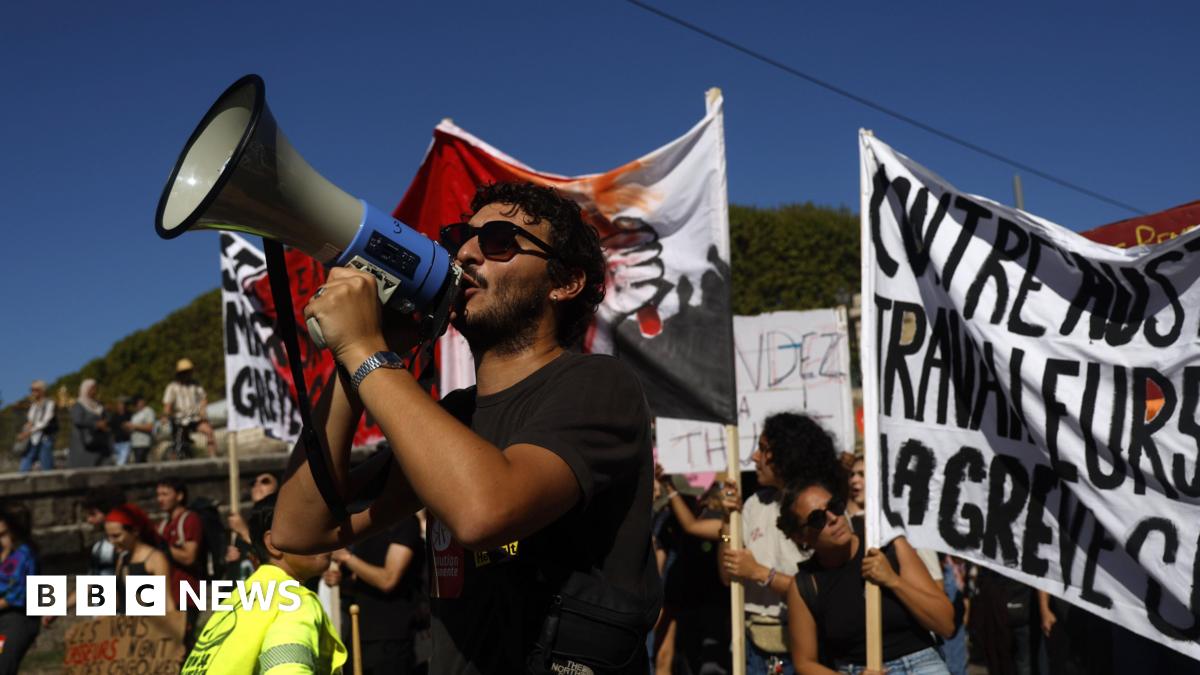
Hundreds of thousands of workers across France are engaged in widespread strikes and protests against proposed €44bn budget cuts, aimed at addressing the nation's significant public debt. The industrial action, involving public transport, teachers, and pharmacists (with 98% of pharmacies closed), has caused substantial disruption and led to scuffles and arrests. This escalating unrest underscores the severe political instability facing new Prime Minister Sébastien Lecornu, whose government inherited a hung parliament and the challenge of balancing fiscal austerity with union demands for increased public spending, a situation that previously led to the downfall of his predecessors.
Widespread industrial action across France, with an estimated 600,000 to 900,000 participants, highlights a severe political and social crisis centered on proposed fiscal austerity. The strikes, which have shut down 98% of pharmacies and involved a third of teachers, are a direct response to a €44 billion budget cut plan aimed at controlling France's spiraling public debt, now equivalent to nearly €50,000 per citizen. This unrest creates immediate and significant challenges for new Prime Minister Sèbastien Lecornu, who took office just a week ago after his predecessor's government was toppled over the same unpopular budget. Lecornu faces a hung parliament, a condition that also led to the downfall of the two previous prime ministers, severely constraining his ability to forge a compromise between fiscal necessity and union demands for higher public spending. The situation signals a period of heightened political instability and policy paralysis, increasing uncertainty over France's fiscal trajectory and its capacity to manage sovereign debt, a risk underscored by the strongly negative sentiment score (-0.7).
AI-powered research, real-time alerts, and portfolio analytics for institutional investors.
Request DemoOverall Sentiment
strongly negative
Sentiment Score
-0.70
