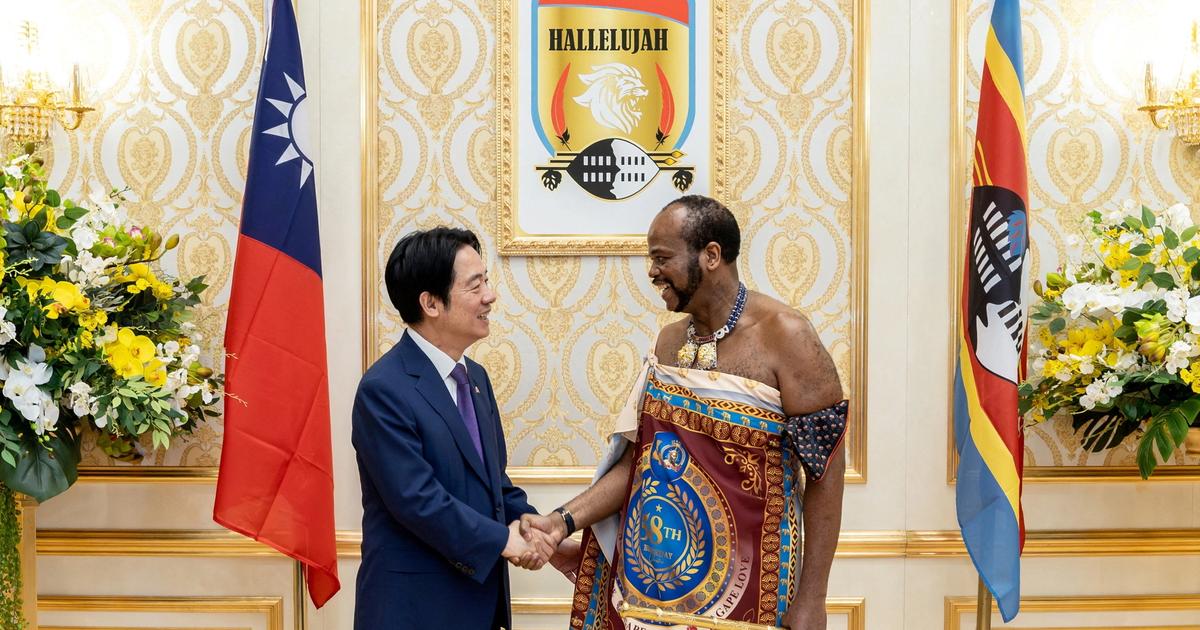
Taiwan’s president Lai Ching-te reached Eswatini after earlier plans to visit were reportedly disrupted by Chinese pressure on neighboring airspace and denied transit requests in Europe. The article highlights Beijing’s efforts to constrain Taiwan’s international presence while China simultaneously removed tariffs across Africa except Eswatini. The news is geopolitically negative for Taiwan and underscores ongoing China-Taiwan tensions, but direct market impact is likely limited.
This is less about Taiwan’s diplomatic choreography and more about China demonstrating it can impose incremental frictions on third countries’ aviation, customs, and access decisions without firing a shot. The immediate market read is not a clean risk-off trigger; instead, it raises the probability of a slow-burn escalation regime where “soft” coercion becomes a repeatable tool. That matters because repeated episode frequency, not headline severity, is what eventually forces multinationals to discount route reliability, regulatory continuity, and air-cargo optionality in Asia-linked supply chains. The more investable second-order effect is on firms with exposure to East Asia transit corridors, semis, and air freight: the risk is not Taiwan per se, but the growing premium on redundancy. Logistics operators, premium air-cargo capacity, and alternate sourcing geographies can see modest multiple support if companies begin paying up for resilience; conversely, lean-in-time inventory models become more vulnerable to margin shock from route disruptions even when final demand is unchanged. This is a months-to-years rerating story, but the catalyst window can be days if Beijing responds with another round of airspace or customs pressure. The contrarian angle is that Eswatini’s exception underscores the limits of China’s Africa push: tariff generosity does not eliminate geopolitical fragmentation, and selective exemptions can backfire by highlighting who is outside the deal rather than who is inside it. Consensus likely overestimates the immediate macro impact and underestimates the signaling value to neutral states: Beijing is willing to spend diplomatic capital to narrow Taiwan’s room to maneuver, but it may also be revealing the boundaries of its influence. If this becomes a pattern, the market should treat it as a volatility amplifier rather than a fundamental earnings event.
AI-powered research, real-time alerts, and portfolio analytics for institutional investors.
Request DemoOverall Sentiment
mildly negative
Sentiment Score
-0.20
