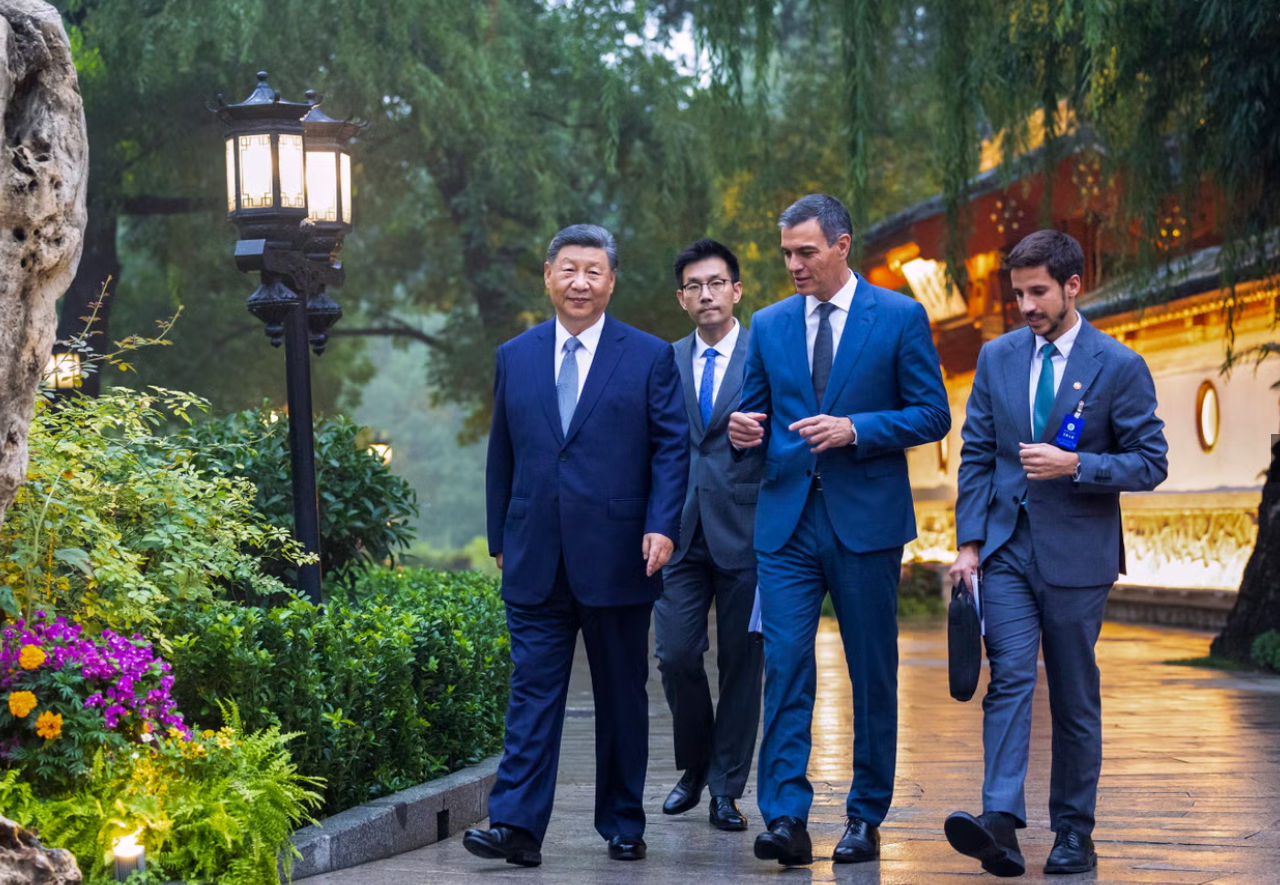
The article describes a broad shift among key U.S. allies toward hedging against America and engaging China more actively, driven by Trump-era unilateralism, tariffs, and uncertainty. Spain, the U.K., France, Canada, the Philippines, and Taiwan are all cited as recalibrating ties, with Canada and the Philippines highlighted as especially notable cases. The implications are geopolitical rather than company-specific, but the trend could affect trade flows, defense alignments, and regional risk premia.
The market implication is not a clean “China bullish” story; it is a fragmentation premium. When allies hedge toward Beijing, the near-term beneficiaries are not Chinese equities broadly but firms that intermediate between blocs: European industrial automation, dual-use aerospace, shipping, and commodity traders that can arbitrage rerouted trade lanes. The bigger second-order effect is capex duplication: governments will spend more on redundant supply chains, port capacity, cyber, and defense, which supports infrastructure and defense names even if nominal trade volumes slow. For Asia, the key risk is that alliance hedging lowers the probability of immediate decoupling while raising the probability of recurring policy shocks. That is structurally negative for tariff-sensitive cyclicals and global semis because procurement teams will diversify sourcing, hold more inventory, and accept lower efficiency to preserve optionality. The result is a modest but persistent margin tax on multinationals with concentrated U.S.-China exposure, especially those with just-in-time exposure in phones, autos, and industrial components. The contrarian point is that the consensus may be overestimating how much room allies actually have to pivot. Europe and Canada can diversify marginally, but security dependence on the U.S. still caps the trade rerating; China also cannot fully substitute for U.S. demand without triggering domestic political resistance in many of these countries. So the durable trade is not a wholesale rotation into China, but a regime of higher volatility, more hedging, and more domestic spending on resilience—conditions that tend to favor defense, gold, and select domestic industrials over globally optimized exporters.
AI-powered research, real-time alerts, and portfolio analytics for institutional investors.
Overall Sentiment
mildly negative
Sentiment Score
-0.15
