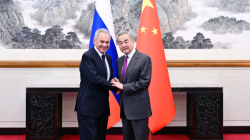
Chinese Foreign Minister Wang Yi met with Russian Security Council Secretary Sergei Shoigu in Beijing on Feb. 1, 2026 for a strategic dialogue that reaffirmed mutual support on core interests, adherence to the one-China principle, opposition to Japan's remilitarization, and coordination within the UN, SCO and BRICS. Marking the 25th anniversary of the 2001 Treaty of Good-Neighborliness, the meeting signals tighter China-Russia strategic alignment that may modestly lower geopolitical uncertainty in Eurasia but is unlikely to trigger immediate market-moving policy shifts.
Market structure: Closer China–Russia strategic coordination disproportionately favors energy and commodity exporters to China, Chinese state-owned banks and logistics providers, and Western defense contractors that supply allies (LMT, RTX, GD). European gas importers and countries dependent on Russian transit routes are the primary losers; expect temporary pricing power for oil/gas and select metals (palladium, nickel) as supply routing and insurance premia rise. FX and rates: expect RUB support via energy trade flows but continued sanction tail-risk keeps RUB volatile; CNY gradual internationalization pressure but capital controls limit near-term appreciation; safe-haven demand should lift gold and increase volatility in core rates and sovereign spreads in Europe.
Risk assessment: Tail risks include a sanctions escalation that triggers secondary sanctions on Chinese firms (low probability, high impact) and a kinetic incident near Taiwan or in the Baltics that spikes commodity prices >10% and equity volatility >30 VIX points. Immediate (days) — risk-off and commodity volatility spikes; short-term (weeks/months) — EM sovereign and corporate spreads widen 50–200bp; long-term (quarters/years) — structural trade realignment and partial de-dollarization that could reprice reserve compositions. Hidden dependencies include China’s semiconductor dependency and Europe’s alternative energy logistics; catalysts that would accelerate moves are formal energy trade deals, BRICS currency initiatives, or large military exercises.
Trade implications: Tactical winners are Western defense equities and energy integrators; establish hedged exposure rather than outright directional leverage. Options are efficient: buy 3-month call spreads on LMT/RTX to capture repricing of defense budgets and buy 2–3 month Brent call spreads to express tail risk in energy with capped loss. Sector rotation: shift 3–5% from EM cyclical and Europe exporters into defense (LMT, RTX, GD), energy (XOM, CVX, XLE) and gold (GLD) over 1–3 months; add increments if Brent > $85/bbl or if a BRICS FX initiative is announced.
Contrarian angles: Consensus underestimates how dependent Russia is on Chinese financing and logistics — over time China will extract favorable energy pricing and equity stakes, capping Russian export margins. The 2014 parallel showed initial price shocks then partial normalization; don’t assume a permanent one-way commodity rally — time positions to catalysts. Unintended consequences include faster Western defense consolidation and accelerated supply-chain bifurcation that hurts global cyclicals and raises idiosyncratic corporate-credit stress in EM names tied to Europe.
AI-powered research, real-time alerts, and portfolio analytics for institutional investors.
Request DemoOverall Sentiment
neutral
Sentiment Score
0.05
