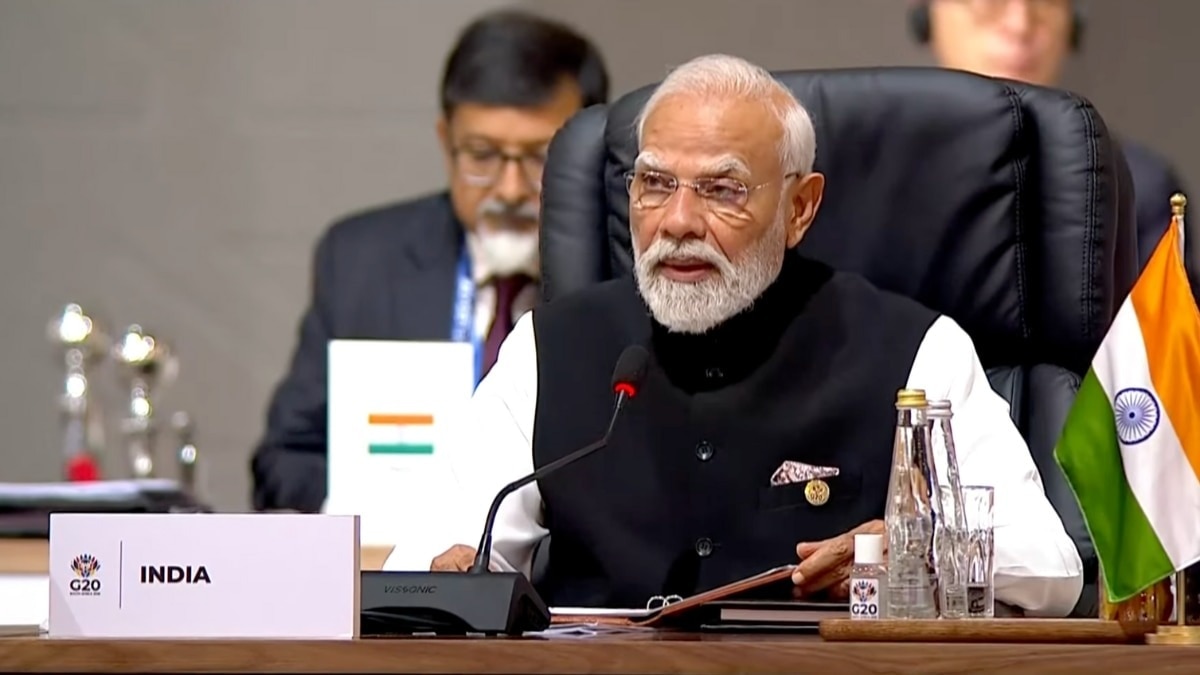
At the G20 Summit in Johannesburg Prime Minister Narendra Modi urged a rethink of global development metrics and unveiled major initiatives including a Global Traditional Knowledge Repository, a G20–Africa Skills Multiplier Initiative (a train‑the‑trainer program targeting one million certified trainers in Africa within a decade), a G20 Global Healthcare Response Team for rapid deployment in crises, and a G20 Initiative to counter the drug–terror nexus focused on synthetic opioids such as fentanyl. The proposals are pitched as tools to advance inclusive, sustainable growth, accelerate African skills and employment pipelines, strengthen collective health resilience and disrupt illicit finance funding terror, and they are expected to shape upcoming G20 negotiations and multilateral funding, capacity‑building and regulatory cooperation over the next decade.
Prime Minister Narendra Modi used the opening session of the G20 Summit in Johannesburg to propose four concrete multilateral initiatives: a Global Traditional Knowledge Repository, a G20–Africa Skills Multiplier Initiative targeting one million certified trainers in Africa within a decade, a G20 Global Healthcare Response Team for rapid deployment during crises, and a G20 Initiative on Countering the Drug–Terror Nexus focused on synthetic opioids such as fentanyl. He framed these proposals as instruments to reset development metrics toward inclusive, sustainable growth and recalled India’s role in elevating the African Union to permanent G20 membership during its presidency.
The Skills Multiplier is explicitly a train‑the‑trainer model intended to scale workforce development across sectors in Africa, while the Healthcare Response Team and anti–drug/terror initiative aim to combine medical, governance and security responses. The Traditional Knowledge Repository is pitched as a cataloguing platform for eco‑balanced practices and cultural know‑how to inform climate and social resilience efforts.
Market implications are directional rather than immediate: these proposals could steer multilateral funding, regulatory cooperation and capacity‑building contracts toward education, health emergency services and security programs in emerging markets. Implementation, financing commitments and intergovernmental coordination are the primary execution risks; absent firm funding timelines, near‑term market impact is likely modest despite a mildly positive sentiment backdrop.
AI-powered research, real-time alerts, and portfolio analytics for institutional investors.
Request DemoOverall Sentiment
mildly positive
Sentiment Score
0.28
