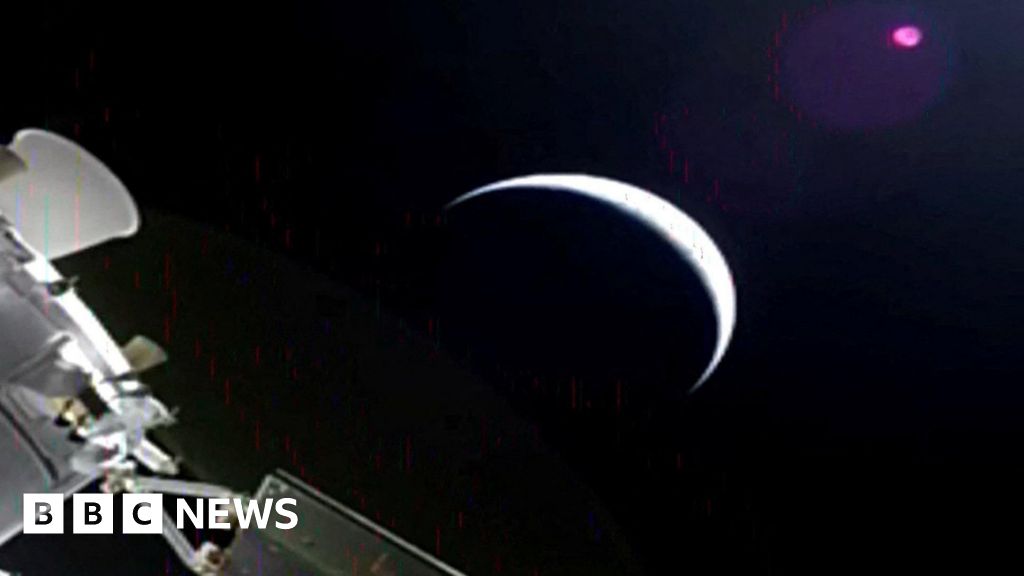
Translunar injection (TLI) — a 5 minute 55 second engine burn — was executed flawlessly, placing Artemis II on a looping trajectory around the far side of the Moon and set to travel >4,700 miles (7,600 km) beyond the Moon at its peak; this marks the first human departure from Earth orbit since 1972. Market impact is negligible in the near term, though continued mission success reinforces long-term investor interest in aerospace & defense suppliers and NASA program contractors rather than producing immediate price moves.
The successful translunar injection materially de-risks program execution for incumbents that built hardware and mission operations for deep-space crewed flight; over the next 12–36 months expect renewed contract wins, follow‑on sustainment work and accelerated procurement of flight‑qualified subsystems (propulsion valves, high‑gain antennas, radiation‑hardened power electronics). That creates a predictable multi‑year revenue tail for large primes and a constrained supplier market where lead times — not raw demand — will set pricing power, particularly for companies that already cleared NASA/DoD qualification hurdles.
Second‑order winners are not the headline ‘space tourism’ names but the service and infrastructure stacks: ground stations, high‑throughput comm satellites, on‑orbit imaging/operators and mission‑simulation/testing vendors. Incremental demand for persistent deep‑space telemetry and EVA training will lift recurring‑revenue software and services lines; this favorably leverages companies with existing DoD/NASA recurring contracts more than one‑off hardware makers.
Primary near‑term risks are binary mission anomalies (hours–days market moves), while medium‑term reversals stem from US budget cycles and congressional scrutiny (6–18 months) that can cut or reallocate appropriations, and from commercial competition that pressures long‑cycle program margins (2–5 years). Watch contractor backlog to bill‑rate conversion and specialized component lead times as the earliest soft signals of margin compression.
The market narrative is still emotionally tilted toward lunar symbolism; that creates a classic misallocation toward retail‑facing, high‑beta names whose cash flows don’t map to deep‑space demand. Prefer balance‑sheeted, cash‑generative primes and infrastructure/service providers over speculative consumer space plays — the former capture durable cash flows from mission sustainment, the latter rely on tenuous consumer adoption and fragile profitability timelines.
AI-powered research, real-time alerts, and portfolio analytics for institutional investors.
Request DemoOverall Sentiment
moderately positive
Sentiment Score
0.40
