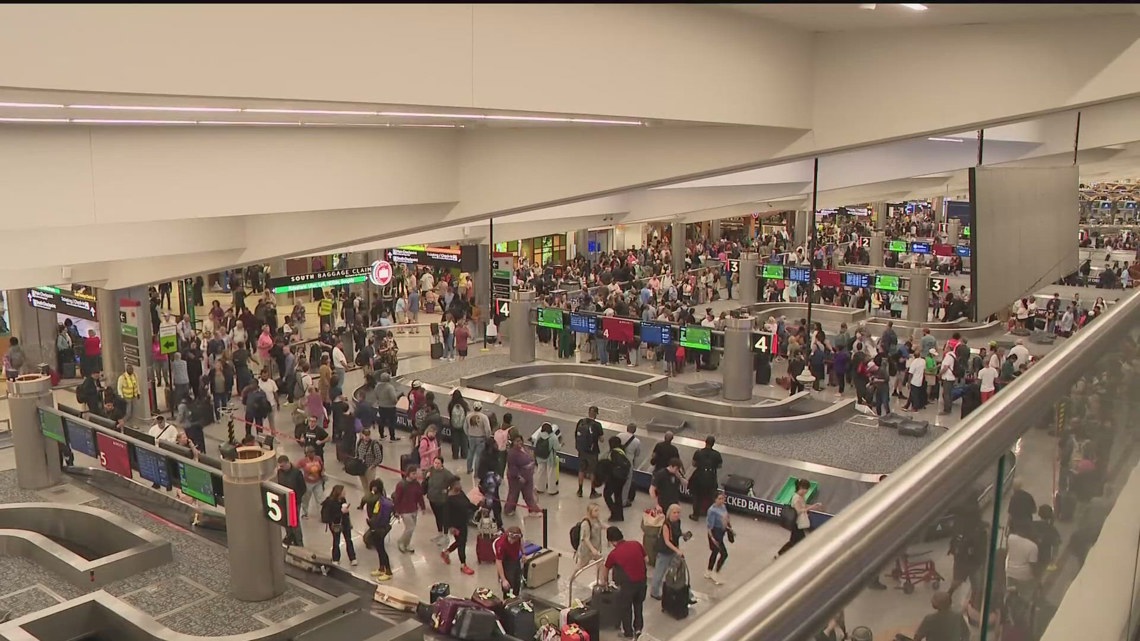
Partial federal shutdown has left TSA checkpoints at Hartsfield-Jackson Atlanta short-staffed, producing wait times of up to multiple hours with some mid-morning windows around 30–45 minutes. Airport advises arriving 3 hours for domestic and 4 hours for international flights; federal agents from ICE/HSI have been temporarily deployed to assist and Delta has issued waivers, but officials warn delays could intensify if staffing isn't restored as Congress negotiates funding.
ATL-centric operational shocks scale nonlinearly: a multi-day staffing shortfall at a global hub imposes outsized rebooking and connection costs on the hub carrier versus point-to-point competitors. If even 1-2% of a hub carrier's daily connecting pax are disrupted for multiple weekends, expect incremental opex (reaccommodation, hotel, waiver-related refunds) on the order of tens of millions over a few weeks — enough to nudge quarterly EPS by several percent given typical airline margins.
Labor and political dynamics create asymmetric timing: a congressional funding solution can compress the pain into days, but durable changes (higher base pay, accelerated hiring, or expanded contractor use) would ratchet up cost structure over quarters. That in turn favors airlines with more geographically diversified networks and those already investing in automation/pre-check alternatives, while raising long-run capex/opex for hub-dependent carriers.
Second-order beneficiaries include automated screening vendors and private security contractors — technology that shortens throughput wins share when manual capacity is constrained. Conversely, airport retail and rental-car economics suffer from reduced same-day throughput and higher no-shows; concessionaires face markdowns and yield loss that materialize over multiple travel-heavy weekends unless service stability returns.
Key catalysts are binary and time-sensitive: a funding vote or large-scale overtime hire could restore normalcy within days, compressing a tactical trading horizon to 1–3 weeks; a protracted impasse, labor walkouts, or a security incident would extend impact to 1–3 months and force structural responses (wage inflation, automation adoption) over 12–24 months. Position sizes should reflect this asymmetric timing risk — small, event-driven stances now with optionality to add on persistence of the shutdown.
AI-powered research, real-time alerts, and portfolio analytics for institutional investors.
Request DemoOverall Sentiment
mildly negative
Sentiment Score
-0.30
Ticker Sentiment
