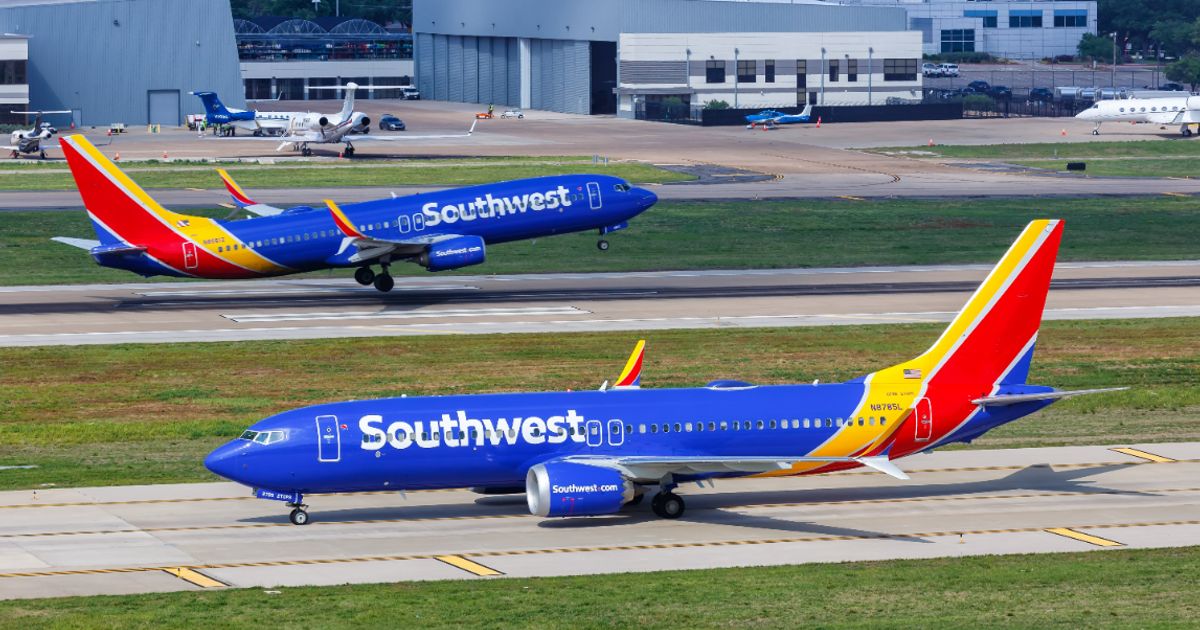
UBS upgraded Southwest Airlines to Buy from Neutral and raised its 12‑month price target to $73 from $51 (≈43% upside), sending shares up ~7%. UBS lifted EPS forecasts to $5.05 for FY2026 (from $4.31) and $6.07 for FY2027 (from $5.12), arguing that Extra Legroom, assigned seating and checked-bag fees could add roughly $4.25–$4.50 in incremental EPS at full maturity by 2027 (≈$2.70 from ELR, $1.70 from bag fees in the base case). The bank models ELR/preferred seat uptake producing ~$1.7bn incremental EBIT (~$2.70 EPS) in its base case and up to $2.9bn EBIT (>$4.50 EPS) in an upside case, plus an additional ~$1.0–$1.5bn EBIT (≈$1.25–$2.15 EPS) from bag-fee adoption.
Market structure: UBS’s upgrade crystallizes a revenue-mix shift — Southwest (LUV) is the direct beneficiary via ELR (+$2.7bn EBIT base) and bag fees (+$1.0–1.5bn EBIT), improving unit revenues on domestic short-haul routes and likely tightening yield dispersion vs. ULCC peers. Losers: pure-ancillary-dependent ULCCs (e.g., SAVE) lose differentiation if LUV captures fee revenue without abandoning network strength; seat retrofit suppliers and MROs see near-term revenue pick-up. Cross-asset: expect LUV credit spreads to compress (tightening corporate bonds), short-term equity IV to fall post-upgrade, and modest downward pressure on fuel-hedge demand if network yields grow (offsetting demand-driven oil impact).
Risk assessment: near-term (days–weeks) reaction risk from sentiment shifts and upgrade-driven flows; short-term (quarters) execution risk — retrofit delays, lower-than-assumed ELR paid-load (<40% base) or bag-fee adoption (<15%) would materially reduce UBS’s $4.25–4.50 EPS increment by FY27. Tail risks include regulatory scrutiny on fee bundling, union/operational constraints increasing opex, or a macro downturn that re-prices corporate travel (UBS did not bake in macro tailwinds). Hidden dependency: revenue elasticity — if ELR cannibalizes higher-yield seats, net uplift falls.
Trade implications: establish a tactical overweight in LUV (2–4% portfolio equity) and hedge execution with a 12–18 month call spread (buy LUV Jan 2027 75C / sell 100C) to cap cost; size to implied vol and target IRR. Pair trade: long LUV / short SAVE (0.6:1 notional) to capture loss of ULCC differentiation; set stop-loss at 15% on either leg. Use options to express asymmetric view — buy Jan 2027 75C LEAPs as a convexo play if ELR take-rates >45% on rollout updates.
Contrarian angles: consensus underweights execution, retrofit capex and customer backlash risks — if ELR paid-load <30% the incremental EBIT could fall below $1.7bn (EPS impact ~<$1.75), making the current re-rate vulnerable. Historical parallel: legacy carriers’ ancillary wins were diluted by competitive responses and regulatory pushback; watch for regulatory inquiries and month-to-month take-rate trends. Action trigger: if company reports ELR paid-load >50% or bag-fee take >20% in two consecutive quarters, add to position; if ELR <30% after rollout or guidance cuts, exit.
AI-powered research, real-time alerts, and portfolio analytics for institutional investors.
Request DemoOverall Sentiment
moderately positive
Sentiment Score
0.55
Ticker Sentiment
