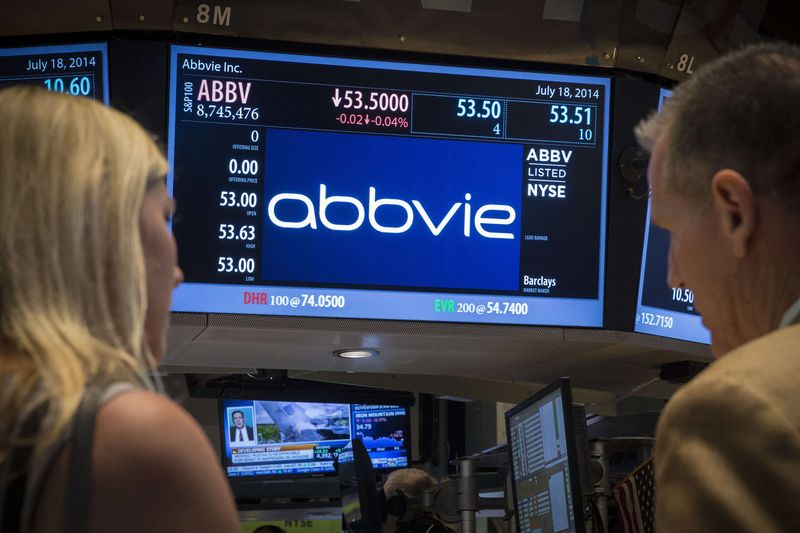
AbbVie delivered a first-quarter beat, with adjusted EPS of $2.65 topping the $2.59 consensus and revenue of $15.0 billion exceeding estimates by $300 million. Canaccord raised its price target to $265 from $262 while maintaining a Buy rating, and AbbVie also lifted 2026 revenue and EPS guidance by $300 million and $0.12, respectively. The company continues to see strength in Skyrizi, Rinvoq, Vraylar and migraine products, with Tavapadon approval expected in Q3 to support Parkinson’s growth.
ABBV’s real setup is not a one-quarter beat; it is a duration trade on whether the market will pay for a multi-year patent bridge being extended by execution rather than just pipeline optionality. The key second-order effect is that strength in immunology/neuroscience reduces the probability of a valuation reset into the next two earnings cycles, because it gives management more room to spend on BD without compromising the dividend or leverage profile. That matters because the stock has been trading as if the post-Humira transition is a finite event, when the evidence now suggests a more durable franchise re-rate if guidance continues ratcheting higher. The competitive issue is less about current share loss and more about how rivals must now price a longer period of intensified defense. If Skyrizi/Rinvoq are still expanding faster than consensus, smaller immunology challengers face a worse capital allocation environment: they either spend harder to defend share or accept slower penetration. That dynamic can also pressure biotech M&A multiples, because ABBV’s ability to pay for late-stage assets increases the floor for assets adjacent to immunology, neuroscience, and Parkinson’s. The main risk is timing mismatch: the market may reward the stock now for the guidance raise, but the next inflection is binary around pipeline execution and the third-quarter Parkinson’s readthrough. If Tavapadon disappoints, the market could quickly reframe the story as “mature cash cow with rich valuation” rather than “self-funded growth compounder.” The other tail risk is that dividend support can mask multiple compression; if growth decelerates even modestly after the next few prints, downside can be 10-15% without any fundamental deterioration beyond consensus disappointment. Consensus looks too focused on near-term immunology strength and not enough on the optionality created by ABBV’s balance sheet and operating cash flow. The underappreciated call here is that management can turn excess cash into a new growth leg before the current one fully matures, which is why the stock could keep grinding higher even if the pipeline only delivers partial success. That makes the setup attractive on dips rather than chasing strength, especially if the market is still anchoring to an old Humira-era valuation framework.
AI-powered research, real-time alerts, and portfolio analytics for institutional investors.
Request DemoOverall Sentiment
moderately positive
Sentiment Score
0.58
Ticker Sentiment
