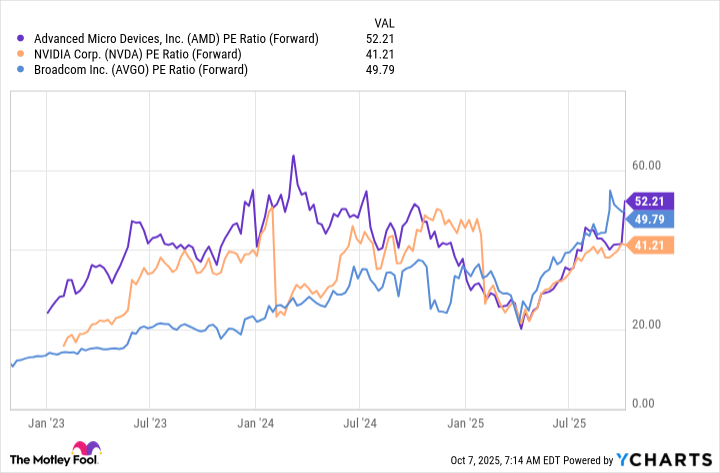
AMD's stock recently surged 24% following an agreement where OpenAI will acquire up to a 10% equity stake in exchange for chips, signaling a potential shift for the company which has significantly underperformed Nvidia year-to-date. While the deal's ultimate value is tied to computing capacity, distinguishing it from Broadcom's firm $10 billion chip order with OpenAI, it marks a significant validation for AMD's AI ambitions. However, AMD still faces intense competition in data center GPUs, and Nvidia's new CPU partnership with Intel could further challenge AMD's market position, with analysts noting AMD's current 52x forward earnings valuation makes it expensive relative to market leaders despite this development.
AMD's stock experienced a significant 24% surge following an agreement where OpenAI will acquire up to a 10% equity stake in AMD in exchange for chips. This deal, potentially valued at $33 billion based on AMD's current $330 billion market capitalization, represents a notable validation for AMD's AI aspirations. However, this equity-based arrangement, vested in stages and contingent on computing capacity build-out, differs from Broadcom's more concrete $10 billion cash order for custom AI accelerators from OpenAI.
Despite this positive development, AMD continues to significantly underperform Nvidia, with its stock up approximately 40% year-to-date compared to Nvidia's roughly 280%. AMD's data center GPUs have yet to establish themselves as viable alternatives to Nvidia's offerings, with custom chips from Broadcom demonstrating stronger traction. Furthermore, Nvidia's new investment partnership with Intel in the CPU realm poses a direct competitive threat, potentially eroding AMD's advantage in providing essential CPUs for data center GPU operations.
The recent stock appreciation has pushed AMD's valuation to 52 times forward earnings, making it appear more expensive than Broadcom and, in some aspects, Nvidia, despite its comparatively weaker growth rates. This elevated valuation, coupled with intense competitive pressures and the conditional nature of the OpenAI deal, raises concerns about the stock's current attractiveness. The prevailing analyst sentiment suggests that owning a second-place company at a premium to the market leader may not present a compelling investment thesis.
AI-powered research, real-time alerts, and portfolio analytics for institutional investors.
Request DemoOverall Sentiment
moderately negative
Sentiment Score
-0.40
Ticker Sentiment
