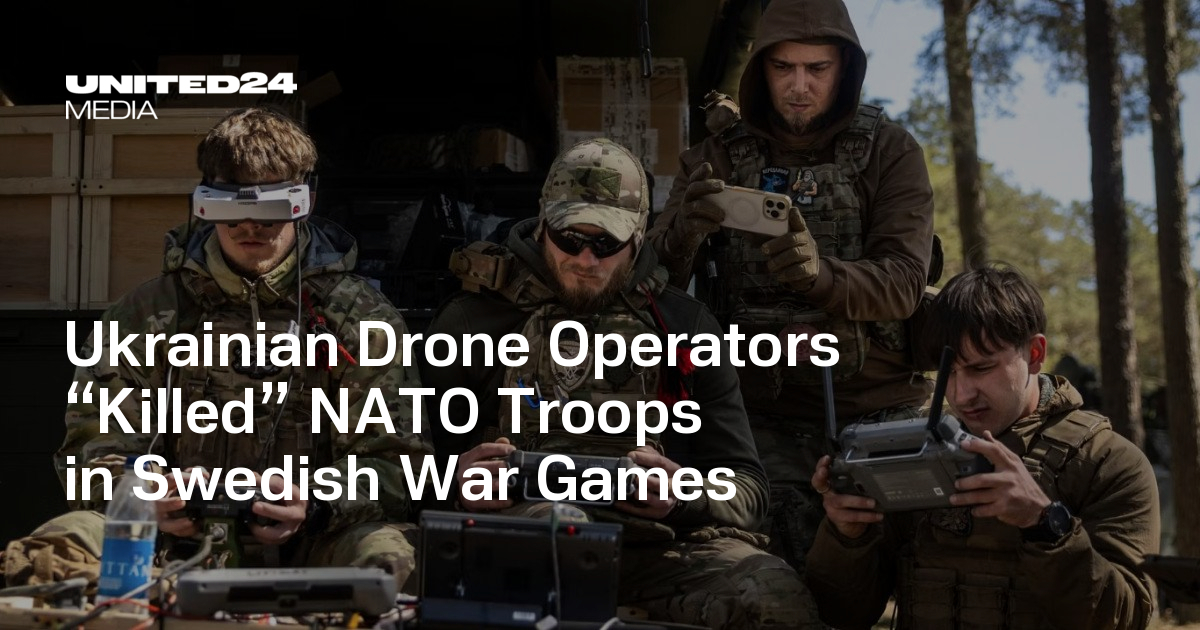
Ukrainian drone operators disrupted Swedish and allied forces during Aurora 26 drills on Gotland, repeatedly forcing training pauses and exposing gaps in NATO drone defense. The exercise highlighted how FPV drones, electronic warfare, concealment, and long-range detection are reshaping modern battlefield tactics. The article underscores accelerating NATO focus on territorial defense and lessons from Ukraine rather than any direct market-specific event.
This is less a headline about Sweden than a validation that low-cost FPV systems are forcing a capital-allocation reset across NATO. The second-order effect is that deterrence is shifting from platform count to kill-chain resilience: dispersed command, rapid concealment, EW hardening, and cheap counter-UAS layers become the real winners, while legacy armor-heavy doctrines and slow procurement cycles are the losers. The message to defense primes is mixed: traditional vehicle and ISR budgets may face pressure, but firms with software-defined EW, sensors, and short-range air defense are likely to see the largest share gains over the next 12-36 months.
The market is likely underestimating how quickly this can translate into budget re-prioritization in Europe. The near-term catalyst is not a single contract but a sequence of emergency procurements after exercises like this force generals to rewrite training standards, with the Baltic/Nordic theater especially vulnerable because of geography and limited strategic depth. That favors names exposed to drone detection, passive survivability, electronic warfare, and tactical communications, while exposing any supplier whose thesis depends on heavy armor modernization alone.
Contrarian view: the consensus may be over-indexing on the headline “drone revolution” and underpricing the countermeasure cycle. FPV dominance is real in permissive environments, but once both sides field dense EW and better detection, attrition economics shift back toward whoever can mass-produce interceptors and integrate sensors fastest. The trade, therefore, is not blindly long drones; it is long the defense stack that monetizes the response to drones, with the strongest upside in firms able to sell across NATO’s urgent procurement wave.
AI-powered research, real-time alerts, and portfolio analytics for institutional investors.
Request DemoOverall Sentiment
neutral
Sentiment Score
-0.05
