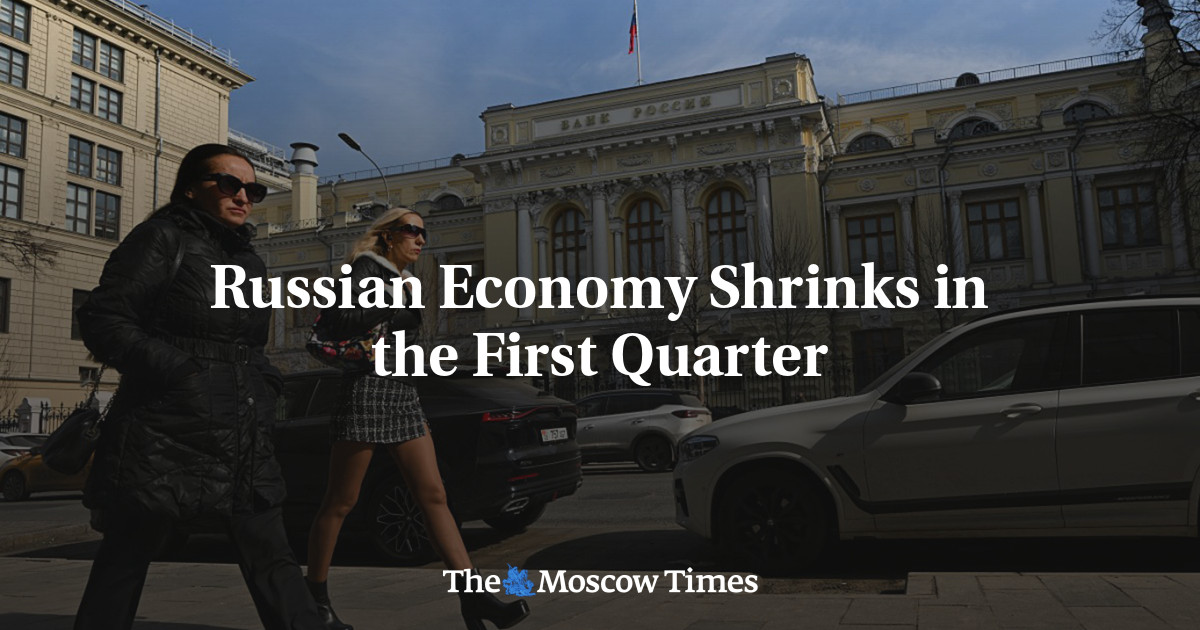
Russia’s GDP contracted 0.5% year-on-year in Q1, missing the central bank’s earlier 1.6% growth projection as weak business activity and lower oil and gas revenues strained public finances. The central bank still expects 0.9% Q2 growth and kept its 2026 GDP forecast at 0.5% to 1.5%, but said it is now more cautious on rate cuts amid inflationary risks and external conditions tied to the war in Iran and energy markets. First-quarter inflation came in at 5.9%, below the prior 6.3% forecast, but borrowing costs remain a drag on manufacturing and investment.
The main equity implication is not a broad “Russia weak” trade so much as a widening internal divergence: state-linked beneficiaries of fiscal prioritization should hold up better than domestic cyclical exposure. Slower activity plus tighter tax take means the budget will be forced to protect defense/energy/strategic sectors at the expense of consumer discretionary, banks, and private industrials, creating a classic crowding-out setup where nominal spending can stay elevated even as real activity deteriorates.
A second-order effect is on the policy path. The central bank is likely to talk dovish into the summer but will have less freedom to ease aggressively if energy shocks re-accelerate prices or if fiscal loosening offsets disinflation. That means front-end yields may not rally as much as the growth scare suggests; the better expression is a steepener, with the market pricing a slower growth regime while term premia stay sticky on budget/commodity risk.
The contrarian point is that a weak first quarter may not be the start of an uncontrollable downturn; it may be a sequencing issue from tax changes and calendar effects that flatters the rebound mechanically in Q2. The bigger medium-term issue is that the economy is becoming more rate- and spending-suppressed at exactly the moment households are losing real income, so the risk is not a sharp crash but a prolonged low-growth, high-inflation equilibrium that compresses private-sector margins for several quarters.
For assets outside Russia, the relevant channel is energy. Any escalation in the Middle East that supports oil prices improves Russia’s export cash flow and weakens the disinflation case globally, which is bad for duration and cyclicals. The market is likely underestimating how a modest oil move can delay easing cycles elsewhere through import-price pass-through and renewed fiscal stress in energy-importing economies.
AI-powered research, real-time alerts, and portfolio analytics for institutional investors.
Request DemoOverall Sentiment
strongly negative
Sentiment Score
-0.60
