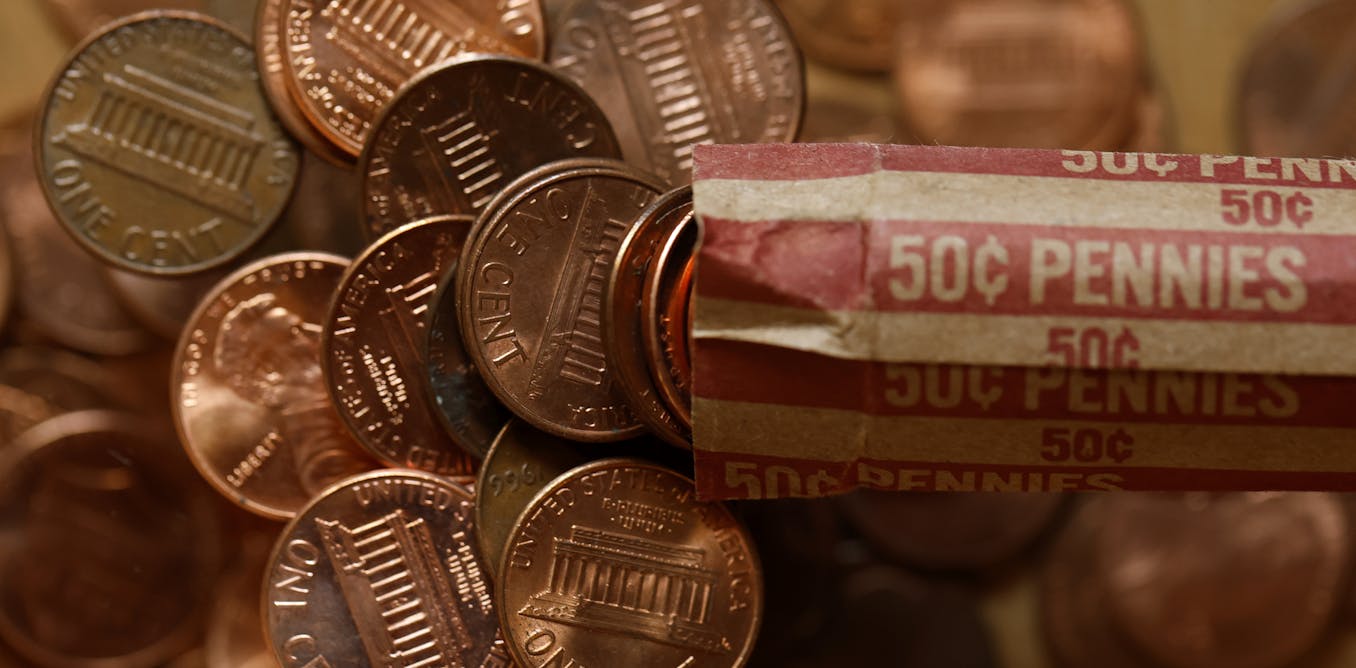
The U.S. Mint struck its final penny on Nov. 12, 2025 pursuant to a White House directive; pennies remain legal tender but will be phased out of circulation, a move that will save the government tens of millions and cut handling and transport costs for banks, credit unions and armored carriers while easing operations for large, scale-sensitive retailers. Small Main Street businesses, however, face a likely shift to rounding cash transactions to the nearest nickel—what Federal Reserve Bank of Richmond researchers call a “rounding tax” that could cost about $6 million annually—and will be further squeezed by relatively high card-processing fees (roughly 2.5–3.5% of sales) as consumers migrate to electronic payments. The change disproportionately harms cash-dependent consumers (the unbanked, underbanked, elderly and low-income households) who cannot offset small price increases, and it accelerates a structural transfer of efficiency gains to larger, technology-enabled firms while raising operational and equity questions given limited federal guidance on implementation.
The U.S. Mint pressed the last 1-cent coin on Nov. 12, 2025 under a White House directive, and each penny costs roughly 4 cents to produce; ending minting is projected to save the federal government tens of millions annually while removing significant handling costs for banks, credit unions and armored carriers. Banks and credit unions will gain from reduced counting, sorting and logistics friction, and large retailers and online-only businesses are advantaged by scale, the ability to reprogram registers and lower negotiated card-processing rates.
Small Main Street merchants face measurable downside: cash transactions will likely be rounded to the nearest nickel, a “rounding tax” the Federal Reserve Bank of Richmond estimates could cost about $6 million annually, and many small merchants already pay roughly 2.5%–3.5% in card-processing fees that erode thin margins on low-ticket sales. The article quantifies payment costs — cash handling at $0.53 per $100 of sales versus $1.12 for signature debit and $0.81 for PIN debit — underscoring that the optimal payment mix is firm-specific and tied to average ticket size.
Cash-dependent consumers (unbanked, underbanked, elderly, low-income) will be disproportionately affected because they cannot capture card rewards or other offsets and will bear rounding impacts directly; industry participants have also flagged limited federal guidance, creating implementation uncertainty. Investors should watch forthcoming policy rules on rounding and merchant pricing, card-fee pass-through behavior, and adoption rates of cashless alternatives to determine which sectors and firms capture net benefits or face structural pressure.
AI-powered research, real-time alerts, and portfolio analytics for institutional investors.
Request DemoOverall Sentiment
mixed
Sentiment Score
0.00
Ticker Sentiment
