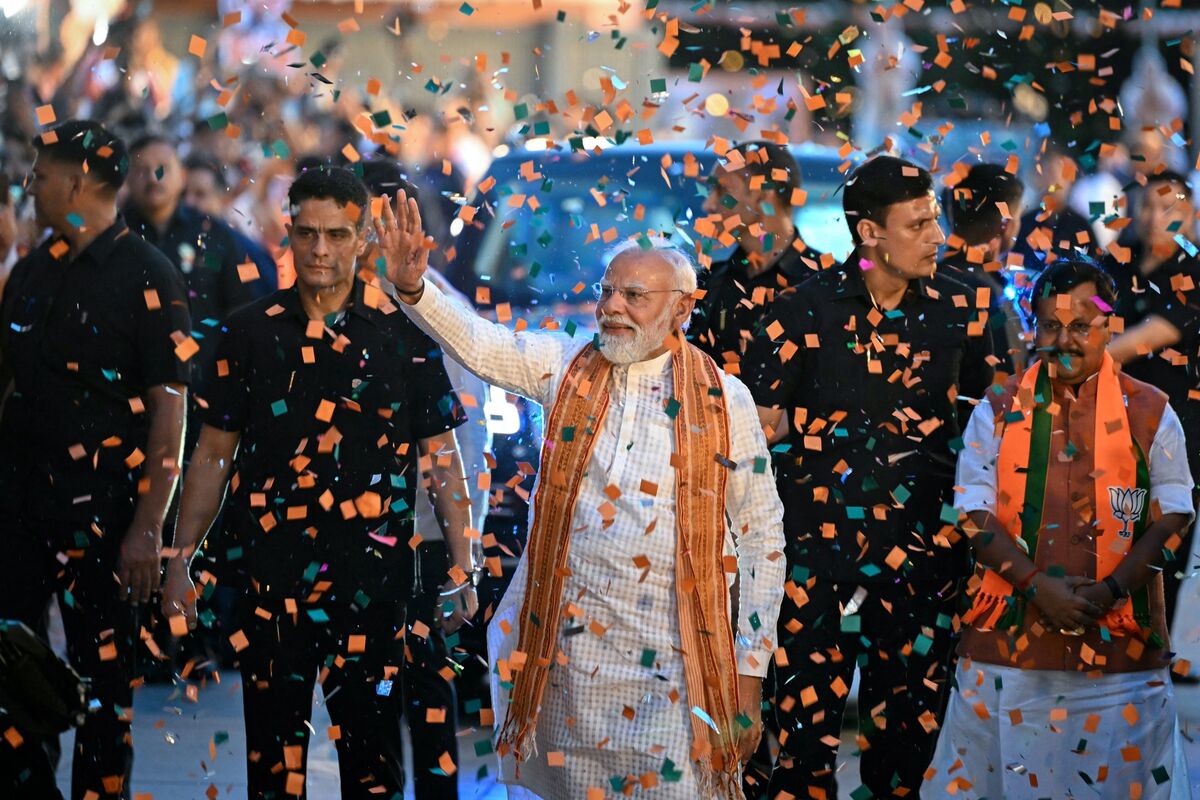
Prime Minister Narendra Modi's BJP won 207 of 294 seats in West Bengal, ending the All India Trinamool Congress's 15-year rule after an unexpectedly large landslide. The result has triggered debate over whether voter-roll changes influenced the outcome, but the article does not provide evidence of a direct market-moving policy shift. The main relevance is political, with limited immediate financial-market impact.
The bigger market signal is not the seat count itself but the precedent: if electoral administration is now perceived as an active policy lever, the next 6-12 months likely bring higher dispute intensity around state-level results, coalition durability, and bureaucratic control. That raises the equity risk premium for India-facing domestic cyclicals that depend on stable local permitting, land acquisition, and subsidy delivery, even if headline growth optics remain intact.
The second-order winners are firms with low exposure to local governance friction and high exposure to central policy transmission: national banks, telecom, defense, rail/logistics, and large-cap consumer names that can out-execute through a more centralized policy architecture. Losers are businesses whose moat depends on state-level relationships or on opposition-run jurisdictions that may face slower approvals, more aggressive audits, or delayed capex execution over the next 2-4 quarters.
The contrarian angle is that markets may overread the result as a clean pro-reform mandate when the more important effect is institutional uncertainty. A perceived rollback of voter-roll neutrality can provoke legal challenges, protest risk, and international NGO scrutiny, which may not hit near-term earnings but can compress multiples for governance-sensitive sectors. For foreign capital, this is less about GDP and more about headline-to-cash-flow conversion: if political noise rises, portfolio flows can turn faster than fundamentals, especially into midcaps and state-dependent plays.
The best setup is to position for a barbell: own central-policy beneficiaries while fading politically exposed domestic beta. The event risk window is immediate to 3 months for legal/political headlines, but 6-18 months for execution impacts on capex and tender awards. Any visible court challenge or evidence of broader electoral irregularities would extend the de-rating; conversely, a quick institutional reset would make this largely fade as a one-off governance overhang.
AI-powered research, real-time alerts, and portfolio analytics for institutional investors.
Request DemoOverall Sentiment
neutral
Sentiment Score
0.00
