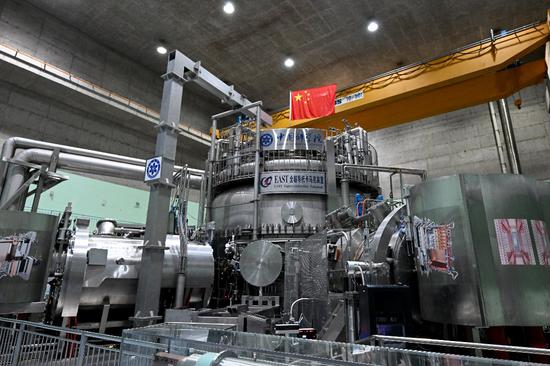
Researchers working on the Experimental Advanced Superconducting Tokamak (EAST) reported in Science Advances that they identified a boundary-driven radiation instability mechanism that triggers the long-recognized plasma density limit and, using a self-organized plasma–wall interaction model, experimentally guided plasma beyond that limit into a newly observed "density-free zone." The work, led by the Hefei Institutes of Physical Science with partners including Huazhong University of Science and Technology and Aix-Marseille University, provides the first experimental confirmation of this regime and establishes a physical basis for higher-density tokamak operation, a development with potential long-term implications for commercial fusion and low-carbon energy supply.
Market structure: Near-term market impact is minimal but the physics advance favors players in superconducting wire, cryogenics and industrial-scale magnet/coil manufacturing (e.g., AMSC, LIN, APD, ABB, GE). If high-density tokamak operation becomes reproducible, demand for niobium-based wire, helium/liquefaction and high‑precision fabrication could rise 10–30% over 5–10 years, improving pricing power for niche suppliers and shifting capex toward specialized OEMs rather than commodity energy providers.
Risk assessment: Main tail risks are technical non‑replication, geopolitical export controls (China vs West) and IP/standards fragmentation; a negative replication outcome would wipe out early speculative premiums. Time horizons: days = no move, weeks–months = modest sentiment trades on funding announcements, years (5–15y) = material capex and supply‑chain reconfiguration; hidden dependencies include rare‑metal supply (niobium), helium availability, and grid integration costs.
Trade implications: Tactical plays favor suppliers over end‑users: long selective suppliers of superconducting components and cryogenics (AMSC, LIN, APD) and industrial integrators (GE, ABB) via equity or LEAPs; avoid long-duration exposure to legacy thermal coal (e.g., short BTU) as fusion reduces long-term baseload demand. Key catalysts to move prices: replication on non‑EAST machines, major government funding announcements, or a commercial demo within 5–8 years.
Contrarian angle: Consensus underestimates downstream timing and overestimates consumer energy disruption; the market likely underprices supply‑chain winners but overprices near-term “fusion” narratives. Action should be patient and conditional on technical replication—if two international tokamaks confirm density‑free operation within 12 months, re‑rate suppliers by 30–50%; if not, reduce exposure by half.
AI-powered research, real-time alerts, and portfolio analytics for institutional investors.
Request DemoOverall Sentiment
mildly positive
Sentiment Score
0.28
