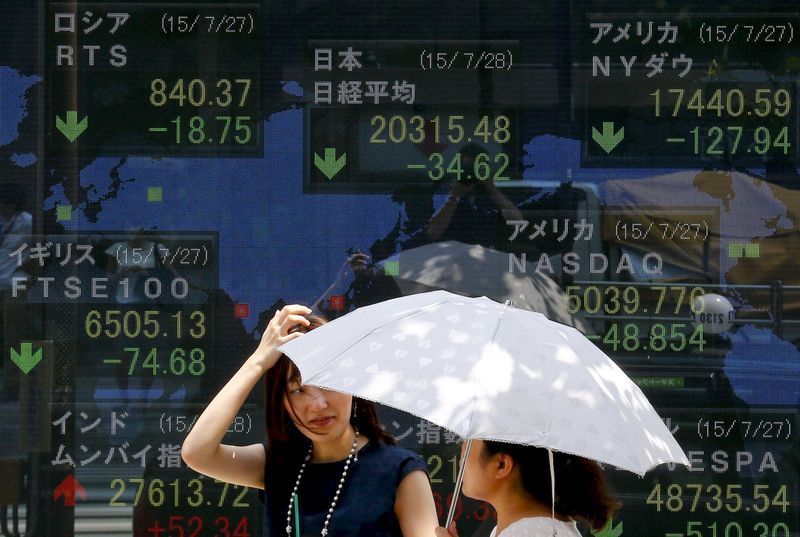
Trump extended the U.S.-Iran ceasefire indefinitely, but stalled peace talks, uncertainty over Iran’s response, and continued disruption in the Strait of Hormuz kept markets cautious. Asian equities were mixed-to-lower, with Hong Kong’s Hang Seng down 1.4%, South Korea’s KOSPI off 0.3%, Australia’s ASX 200 down 1.0%, while Japan’s Nikkei 225 rose 0.5% to a record 59,708.21. Japan’s March exports climbed 11.7% year-on-year and imports rose 10.9%, both above forecasts, as attention also turned to Kevin Warsh’s Fed testimony emphasizing central bank independence.
The immediate market read is too complacent on “ceasefire extension = risk-on.” The more important second-order effect is that headline de-escalation can coexist with a still-fragile energy logistics regime: if the Strait remains intermittently constrained, equities get the benefit of lower war-premium volatility while consumers and cyclicals still absorb a latent oil-tax. That is a negative for transport, chemicals, and Asian importers with thin margin buffers, even if the broad index reaction is muted.
Japan is the cleanest beneficiary on a relative basis, but not simply because of the equity tape. A weaker geopolitical backdrop lowers imported inflation pressure and gives domestic cyclicals more room to rerate, while the export beat suggests external demand is not rolling over yet; that combination supports a Japan overweight versus other Asia where energy import sensitivity is higher. The catch is that the TOPIX lagging the Nikkei hints at index leadership being narrow and flow-driven rather than a broad macro improvement, which makes the rally more fragile over the next 1-3 weeks.
Technology weakness looks more like duration-sensitive profit-taking than a fundamental growth reset. If yields remain stable and geopolitical stress fades, semis should recover quickly; if energy prices stay sticky, however, the market could continue rotating out of high-multiple software/hardware into cash-generative defensives and Japan/financials. The key contrarian point is that the ceasefire extension may actually reduce the probability of a disorderly equity drawdown without removing the underlying inflation impulse, a setup that historically favors value over growth and domestically oriented earners over global macro beta.
The Fed hearing matters because it keeps rate-cut expectations from re-anchoring too dovishly just as geopolitics threatens imported inflation. That combination limits the upside for long-duration assets and argues for selective hedges rather than outright risk-off positioning. Over the next month, the market likely trades on whether diplomacy translates into shipping normalization; absent that, the “peace dividend” will be overstated.
AI-powered research, real-time alerts, and portfolio analytics for institutional investors.
Request TrialOverall Sentiment
neutral
Sentiment Score
-0.05
