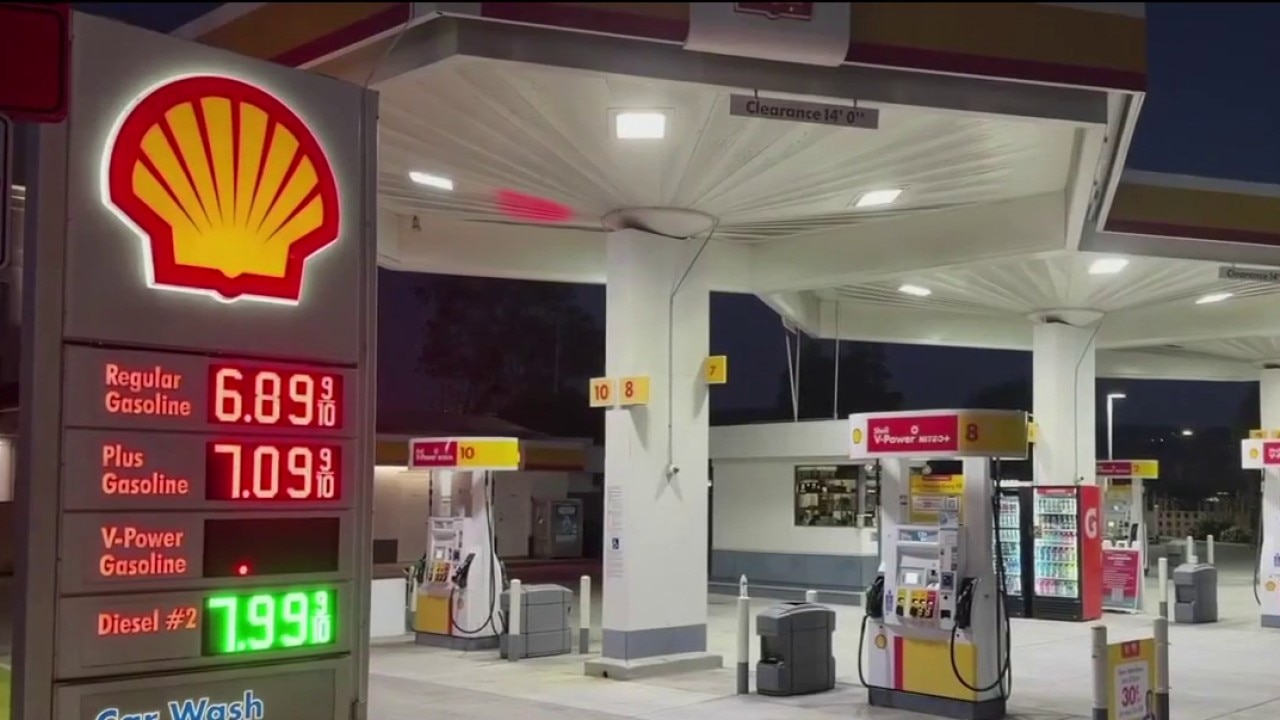
Regular gas hit $6.89/gal at a Shell in South San Francisco (AAA national average $3.97, California average $5.82) while a downtown Los Angeles Chevron was selling for $8.71/gal. Prices have surged since the war in Iran and disruptions to the Strait of Hormuz; economists project a nationwide peak near $4.36/gal in May and AAA notes last year's US/CA averages were $3.13/$4.64 (California's prior record was $6.44 on June 14, 2022). The increase will disproportionately hurt lower-income households (bottom 10% spend ~4% of income on gasoline), could add roughly $740 in gas costs per household this year, and is expected to weigh on consumer spending and growth, creating a volatile, risk-off market backdrop.
Retail fuel exposures and integrated upstream/refining exposures are decoupling in this shock: branded retail operators (high fixed-location cost, high working-capital tied to daily pump volumes) will see revenue-per-site fall faster than integrated majors recover upstream cash flow. Convenience-store gross margins cushion some pain, but that income is limited by lower foot traffic and a time-lagged inventory accounting mismatch that amplifies losses for smaller retailers.
A chokepoint-driven supply shock raises shipping & insurance costs and lengthens physical delivery windows, which benefits refiners with secure domestic crude access while penalizing players dependent on seaborne imports and spot rack pricing. That persistence in logistics friction makes refined-product scarcity a longer-duration problem than a pure crude-price spike would imply, increasing regional crack spreads but also creating a two-speed market between coastal and inland markets.
Macro and demand-side second-order effects are non-linear: low-income households reallocate discretionary spending quickly, creating outsized downside for restaurants, quick-service retailers, and short-haul transit in states with high pump prices. Credit and collections for auto and credit-card books can deteriorate within one to three quarters, amplifying regional banking and SMB stress where fuel is a larger share of household budgets.
Reversal catalysts are identifiable and relatively near-term: diplomatic de-escalation, coordinated SPR releases, or reopening of maritime routes would compress volatility in days–weeks; refinery restarts and rerouting of barrel flows take months. The market may be over-discounting persistence because contango/storage economics and idled refining capacity typically accelerate a partial supply restoration within 2–4 months once price signals stabilize, but regulatory interventions and local price-gouging probes can keep retail prices sticky beyond that horizon.
AI-powered research, real-time alerts, and portfolio analytics for institutional investors.
Request DemoOverall Sentiment
strongly negative
Sentiment Score
-0.60
Ticker Sentiment
